
17,005 Documents in our Technical Library
3230269 Total Downloads

Newest Additions

NASA-RP-1060 Subsonic Aircraft: Evolution and the Matching of Size to Performance
AA-CP-20212-001
AA-CP-20212-001
ADPO10769 Occurrence of Corrosion in Airframes
The purpose of this lecture is to provide an overview ...
MIL-STD-1759 Rivets and Rivet Type Fasteners Preferred for Design
The purpose of this book form standard is to provide ...
MIL-STD-810G Environmental Engineering Considerations and Laboratory Tests
This standard contains materiel acquisition program planning and engineering direction ...

naca-tn-2016

  • Version
  • 130 Downloads
  • 1.96 MB File Size
  • 1 File Count
  • December 13, 2016 Create Date
  • December 13, 2016 Last Updated
Scroll for Details

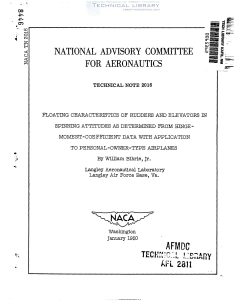
National Advisory Committee for Aeronautics, Technical Notes - Floating Characteristics of Rudders and Elevators in Spinning Attitudes as Determined from Hinge Moment Coefficient Data with Application to Personal Owner Type Airplanes
A study was made of available rudder and elevator hinge—moment—
coefficient data in order to determine the floating characteristics of
various types of rudders and elevators in spinning attitudes. Some
of the data were applied to specific spin attitudes obtained from
tests of a model of a typical personal—owner-type airplane in the
Langley 20—foot free—spinning tunnel. The results were studied with
regard to obtaining spin‘recovery upon releasing the controls.

The plain rudder generally floated with the spin at all spinning
attitudes. 0f the rudders investigated, the horn—balanced rudder
should be the most adaptable for obtaining desirable floating charac—
teristics at spinning attitudes. The partial—length overhangébalanced
rudder (rudder above the horizontal tail) should float near neutral
for steep spins and against the spin for flatter spins. The full—
length overhang—balanced rudder (a part of the rudder extending below
the horizontal tail), however, may float with the spin.

Plain, overhang4balanced, and beveled—trailingeedge elevators
should float in an up position in spins although the beveled—trailing—
edge elevator should float closest to neutral from an up position.
Horn—balanced elevators should also float in an up position. use of
large tabs deflected up should cause the elevator to float down in
spinning attitudes.

The problem of spin recovery has been extensively studied in
the past from the viewpoint of obtaining recovery by rapid manual
movement of the controls. References l and 2 present results of such
studies that may be considered applicable to personal—owner—type
airplanes. Civil Air Regulations, however, require_personal—owner—type
airplanes to recover from spins upon releasing the controls. (See
reference 3.) Some recent designs of personalrownerhtype airplanes
are considerably heavier than those of the past and difficulty has
been encountered in complying with these Civil Air Regulations.

FileAction
naca-tn-2016 Floating Characteristics of Rudders and Elevators in Spinning Attitudes as Determined from.pdfDownload 

Comment On This Post

Your email address will not be published. Required fields are marked *

naca-tn-2016

  • Version
  • 130 Downloads
  • 1.96 MB File Size
  • 1 File Count
  • December 13, 2016 Create Date
  • December 13, 2016 Last Updated
Scroll for Details

National Advisory Committee for Aeronautics, Technical Notes - Floating Characteristics of Rudders and Elevators in Spinning Attitudes as Determined from Hinge Moment Coefficient Data with Application to Personal Owner Type Airplanes

A study was made of available rudder and elevator hinge—moment—
coefficient data in order to determine the floating characteristics of
various types of rudders and elevators in spinning attitudes. Some
of the data were applied to specific spin attitudes obtained from
tests of a model of a typical personal—owner-type airplane in the
Langley 20—foot free—spinning tunnel. The results were studied with
regard to obtaining spin‘recovery upon releasing the controls.

The plain rudder generally floated with the spin at all spinning
attitudes. 0f the rudders investigated, the horn—balanced rudder
should be the most adaptable for obtaining desirable floating charac—
teristics at spinning attitudes. The partial—length overhangébalanced
rudder (rudder above the horizontal tail) should float near neutral
for steep spins and against the spin for flatter spins. The full—
length overhang—balanced rudder (a part of the rudder extending below
the horizontal tail), however, may float with the spin.

Plain, overhang4balanced, and beveled—trailingeedge elevators
should float in an up position in spins although the beveled—trailing—
edge elevator should float closest to neutral from an up position.
Horn—balanced elevators should also float in an up position. use of
large tabs deflected up should cause the elevator to float down in
spinning attitudes.

The problem of spin recovery has been extensively studied in
the past from the viewpoint of obtaining recovery by rapid manual
movement of the controls. References l and 2 present results of such
studies that may be considered applicable to personal—owner—type
airplanes. Civil Air Regulations, however, require_personal—owner—type
airplanes to recover from spins upon releasing the controls. (See
reference 3.) Some recent designs of personalrownerhtype airplanes
are considerably heavier than those of the past and difficulty has
been encountered in complying with these Civil Air Regulations.

FileAction
naca-tn-2016 Floating Characteristics of Rudders and Elevators in Spinning Attitudes as Determined from.pdfDownload 
17,005 Documents in our Technical Library
3230269 Total Downloads

Search The Technical Library

Newest Additions

NASA-RP-1060 Subsonic Aircraft: Evolution and the Matching of Size to Performance
AA-CP-20212-001
AA-CP-20212-001
ADPO10769 Occurrence of Corrosion in Airframes
The purpose of this lecture is to provide an overview ...
MIL-STD-1759 Rivets and Rivet Type Fasteners Preferred for Design
The purpose of this book form standard is to provide ...
MIL-STD-810G Environmental Engineering Considerations and Laboratory Tests
This standard contains materiel acquisition program planning and engineering direction ...