
17,005 Documents in our Technical Library
3247461 Total Downloads

Newest Additions

NASA-RP-1060 Subsonic Aircraft: Evolution and the Matching of Size to Performance
AA-CP-20212-001
AA-CP-20212-001
ADPO10769 Occurrence of Corrosion in Airframes
The purpose of this lecture is to provide an overview ...
MIL-STD-1759 Rivets and Rivet Type Fasteners Preferred for Design
The purpose of this book form standard is to provide ...
MIL-STD-810G Environmental Engineering Considerations and Laboratory Tests
This standard contains materiel acquisition program planning and engineering direction ...

naca-tn-1803

  • Version
  • 74 Downloads
  • 1.26 MB File Size
  • 1 File Count
  • December 8, 2016 Create Date
  • December 8, 2016 Last Updated
Scroll for Details

National Advisory Committee for Aeronautics, Technical Notes - Downwash in the Vertical and Horizontal Planes of Symmetry Behind a Triangular Wing in Supersonic Flow
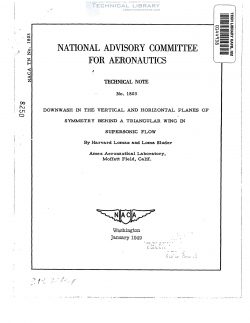
A method developed in a previous report for finding the induced
velocity field. behind a supersonic wing with known load distribution
is used to find the downwash behind a triangular wing with subsonic
leading edges. Results are given for the chord plane in the extended
vortex wake of the wing and for the vertical plane of symmetry up to
about 20 percent of the wing span above the plane of the wing.

A method has been developed in reference 1 for comting the
downwash behind wings of known loading flying at supersonic speeds.
The solution was based on the distribution of supersonic doublets
over the plan form and wake of the wing in a manner determined by
the load distribution. The method was applied in reference 1 to
the calculation of the downwash behind a triangular wing with
leading edges swept behind the Mach cone from the vertex. Near the
trailing edge, however, these calculations were limited to a region
close to an extension of the center line of the wing, that is, the
x axis (fig. 1), and in fact were exact only on this line itself.

A simple first approximtion was advanced for the downwash variation
about the x axis; namely, that the difference in the Vdownwash at the
position (x,y,z) from the value at the position (x,0,0) was a linear
function of the 2 distance and independent of the y distance.
However, the accuracy of this approximation could be tested only for
large values of x where the downwash was known for all values of ,
y and z.

The purpose of this report is threefold: First, to continue
the exact calculations so as to include all points on the xy and
xz planes behind the trailing edge for distances up to about a
semispan from the x axis in the x5} plane and up to about llo percent
of a semispan in the xz plane; second, to compare these values of
downwash with those obtained from the approximate method given in
reference 1; and, third, to serve as a. guide through some of the
more difficult mathemtical manipulations so that the calculations
can be extended to other plan forms.

FileAction
naca-tn-1803 Downwash in the Vertical and Horizontal Planes of Symmetry Behind a Triangular Wing in Supersonic Flow.pdfDownload 

Comment On This Post

Your email address will not be published. Required fields are marked *

naca-tn-1803

  • Version
  • 74 Downloads
  • 1.26 MB File Size
  • 1 File Count
  • December 8, 2016 Create Date
  • December 8, 2016 Last Updated
Scroll for Details

National Advisory Committee for Aeronautics, Technical Notes - Downwash in the Vertical and Horizontal Planes of Symmetry Behind a Triangular Wing in Supersonic Flow

A method developed in a previous report for finding the induced
velocity field. behind a supersonic wing with known load distribution
is used to find the downwash behind a triangular wing with subsonic
leading edges. Results are given for the chord plane in the extended
vortex wake of the wing and for the vertical plane of symmetry up to
about 20 percent of the wing span above the plane of the wing.

A method has been developed in reference 1 for comting the
downwash behind wings of known loading flying at supersonic speeds.
The solution was based on the distribution of supersonic doublets
over the plan form and wake of the wing in a manner determined by
the load distribution. The method was applied in reference 1 to
the calculation of the downwash behind a triangular wing with
leading edges swept behind the Mach cone from the vertex. Near the
trailing edge, however, these calculations were limited to a region
close to an extension of the center line of the wing, that is, the
x axis (fig. 1), and in fact were exact only on this line itself.

A simple first approximtion was advanced for the downwash variation
about the x axis; namely, that the difference in the Vdownwash at the
position (x,y,z) from the value at the position (x,0,0) was a linear
function of the 2 distance and independent of the y distance.
However, the accuracy of this approximation could be tested only for
large values of x where the downwash was known for all values of ,
y and z.

The purpose of this report is threefold: First, to continue
the exact calculations so as to include all points on the xy and
xz planes behind the trailing edge for distances up to about a
semispan from the x axis in the x5} plane and up to about llo percent
of a semispan in the xz plane; second, to compare these values of
downwash with those obtained from the approximate method given in
reference 1; and, third, to serve as a. guide through some of the
more difficult mathemtical manipulations so that the calculations
can be extended to other plan forms.

FileAction
naca-tn-1803 Downwash in the Vertical and Horizontal Planes of Symmetry Behind a Triangular Wing in Supersonic Flow.pdfDownload 
17,005 Documents in our Technical Library
3247461 Total Downloads

Search The Technical Library

Newest Additions

NASA-RP-1060 Subsonic Aircraft: Evolution and the Matching of Size to Performance
AA-CP-20212-001
AA-CP-20212-001
ADPO10769 Occurrence of Corrosion in Airframes
The purpose of this lecture is to provide an overview ...
MIL-STD-1759 Rivets and Rivet Type Fasteners Preferred for Design
The purpose of this book form standard is to provide ...
MIL-STD-810G Environmental Engineering Considerations and Laboratory Tests
This standard contains materiel acquisition program planning and engineering direction ...