17,005 Documents in our Technical Library
3206378 Total Downloads

Newest Additions

NASA-RP-1060 Subsonic Aircraft: Evolution and the Matching of Size to Performance
AA-CP-20212-001
AA-CP-20212-001
ADPO10769 Occurrence of Corrosion in Airframes
The purpose of this lecture is to provide an overview ...
MIL-STD-1759 Rivets and Rivet Type Fasteners Preferred for Design
The purpose of this book form standard is to provide ...
MIL-STD-810G Environmental Engineering Considerations and Laboratory Tests
This standard contains materiel acquisition program planning and engineering direction ...

AGARD-R-786

AGARD-R-786
  • Version
  • 233 Downloads
  • 116.47 MB File Size
  • 1 File Count
  • April 12, 2016 Create Date
  • February 27, 2019 Last Updated
Scroll for Details

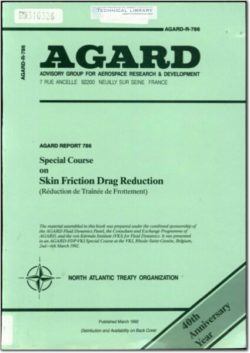
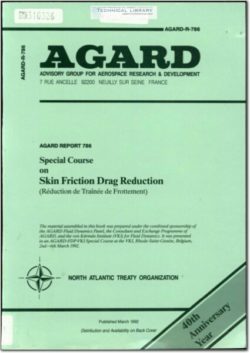
Skin Friction Drag Reduction

AGARD-R-786 Skin Friction Drag Reduction

Since man has been trying to fly, a war against drag
has been engaged. At the present time, drag reduc~
tion is an industrial challenge in Aeronautics which
justifies the efforts devoted to this topic. One facet
of these efforts deals with the skin-friction drag re-
dution. Two directions are followed. The first one is
the manipulation of turbulent boundary layers. By
altering the formation of turbulence or by modifying
its characteristics it is hoped to decrease the turbu-
lent skin-friction. The second direction concerns the
action on laminar-turbulent transition. By delaying
the occurence of the turbulent regime enormous skin—
friction reductions are possible.

This Lecture Series on Skin-Friction Drag Reduc-
tion is aimed at giving an overview of the state of the
art on the various means which are being studied to
obtain significant gains. It is believed that the im-
provements in this field are based on a better knowl-
edge of the basic phenomena (transition and turbu-
lence) we want to play with in the boundary layer.
Thus a few lectures are devoted to describe these fun-
damental materials and the present paper reminds
the useful concepts on boundary layers which are
needed to approach the more specialized questions.

The drag of an aircraft is produced by the pressure
forces and the friction forces which act on the surface
of the body. On a commercial transport transonic
aircraft about 45% of the drag is due to the skin
friction of the wings, fuselage, fin, etc.

The skin friction is a direct effect of viscosity which
has also indirect effects on the pressure drag. Let us
take the simple example of a two-dimensional airfoil
in incompressible flow. In inviscid fluid, the drag is
null. In viscous fluid, the Joukovsky condition at
the trailing no longer applies and a pressure drag is
induced. It is the presence of the boundary layer
and the wake which produce this additional drag.
Very often the drag is decomposed into an induced
drag (induced by the lift), viscous drag, wave drag,
interference drag, etc. This is simply another decom-
position which can be useful to analyse the various
sources of drag and to separate various physical phe-
nomena.

FileAction
AGARD-R-786 Skin Friction Drag Reduction.pdfDownload 

Comment On This Post

Your email address will not be published. Required fields are marked *

AGARD-R-786

AGARD-R-786
  • Version
  • 233 Downloads
  • 116.47 MB File Size
  • 1 File Count
  • April 12, 2016 Create Date
  • February 27, 2019 Last Updated
Scroll for Details

Skin Friction Drag Reduction

AGARD-R-786 Skin Friction Drag Reduction

Since man has been trying to fly, a war against drag
has been engaged. At the present time, drag reduc~
tion is an industrial challenge in Aeronautics which
justifies the efforts devoted to this topic. One facet
of these efforts deals with the skin-friction drag re-
dution. Two directions are followed. The first one is
the manipulation of turbulent boundary layers. By
altering the formation of turbulence or by modifying
its characteristics it is hoped to decrease the turbu-
lent skin-friction. The second direction concerns the
action on laminar-turbulent transition. By delaying
the occurence of the turbulent regime enormous skin—
friction reductions are possible.

This Lecture Series on Skin-Friction Drag Reduc-
tion is aimed at giving an overview of the state of the
art on the various means which are being studied to
obtain significant gains. It is believed that the im-
provements in this field are based on a better knowl-
edge of the basic phenomena (transition and turbu-
lence) we want to play with in the boundary layer.
Thus a few lectures are devoted to describe these fun-
damental materials and the present paper reminds
the useful concepts on boundary layers which are
needed to approach the more specialized questions.

The drag of an aircraft is produced by the pressure
forces and the friction forces which act on the surface
of the body. On a commercial transport transonic
aircraft about 45% of the drag is due to the skin
friction of the wings, fuselage, fin, etc.

The skin friction is a direct effect of viscosity which
has also indirect effects on the pressure drag. Let us
take the simple example of a two-dimensional airfoil
in incompressible flow. In inviscid fluid, the drag is
null. In viscous fluid, the Joukovsky condition at
the trailing no longer applies and a pressure drag is
induced. It is the presence of the boundary layer
and the wake which produce this additional drag.
Very often the drag is decomposed into an induced
drag (induced by the lift), viscous drag, wave drag,
interference drag, etc. This is simply another decom-
position which can be useful to analyse the various
sources of drag and to separate various physical phe-
nomena.

FileAction
AGARD-R-786 Skin Friction Drag Reduction.pdfDownload 
17,005 Documents in our Technical Library
3206378 Total Downloads

Search The Technical Library

Newest Additions

NASA-RP-1060 Subsonic Aircraft: Evolution and the Matching of Size to Performance
AA-CP-20212-001
AA-CP-20212-001
ADPO10769 Occurrence of Corrosion in Airframes
The purpose of this lecture is to provide an overview ...
MIL-STD-1759 Rivets and Rivet Type Fasteners Preferred for Design
The purpose of this book form standard is to provide ...
MIL-STD-810G Environmental Engineering Considerations and Laboratory Tests
This standard contains materiel acquisition program planning and engineering direction ...