
DSTO-TR-2622
- Version
- 191 Downloads
- 342.14 KB File Size
- 1 File Count
- August 10, 2016 Create Date
- August 10, 2016 Last Updated
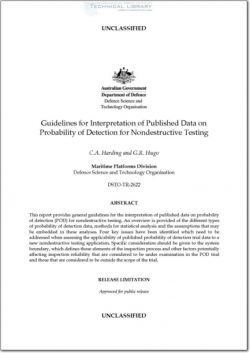
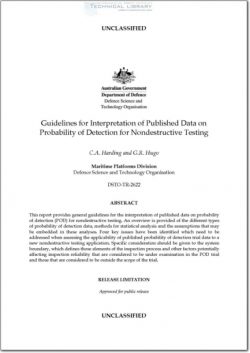
Guidelines for Interpretation of Published Data on Probability of Detection for Nondestructive Testing
Nondestructive testing1 (NDT) is used to search for defects in structural materials and
components, usually for the purpose of assessing whether the material or component is
safe or fit for use. NDT is used widely for detection of fatigue cracking and corrosion in
metals; porosity, fusion defects and cracks in welds, and disbonds or other anomalies in
composite components. NDT methods may also be used to confirm correct assembly of
parts or measure component dimensions (e.g. thickness). Some NDT applications are
safety—critical, whereas others form part of purely preventative maintenance processes
aimed at minimizing more expensive maintenance at a later date.
There are a variety of NDT methods available with differing capabilities. One of the key
features that determines appropriate applications of an NDT method is the minimum
defect size, aNDI, which can be reliably detected by a technique, relative to the sizes of
defects that might be structurally significant. The detectable defect size, and the
reliability with which it can be detected, are dependent on many factors, not least of
which can be the inherent variability in the characteristics of the defects to be detected.
In some cases, for example, inspection of welds, the detectable defect size may be
dependant on the specific weld geometry and the specific locations of possible defects
within the weld.
Objective knowledge of the reliability of NDT is particularly important for aerospace
applications, since NDT (both during production and in service) is a key element of
structural integrity management and minimum standards for NDT reliability are
specified in airworthiness codesz. Failure of NDT to detect a defect may have a variety
of consequences including unavailability of aircraft, increased maintenance costs, or
catastrophic failure of safety-critical structure. Studies of NDT reliability are usually
focused on avoiding catastrophic failure and demonstrating that the requirements set
out in airworthiness standards are achieved.
| File | Action |
|---|---|
| DSTO-TR-2622 Guidelines for Interpretation of Published Data on Probability of Detection for Nondestructive Testing.pdf | Download |
Comment On This Post