17,005 Documents in our Technical Library
3210538 Total Downloads

Newest Additions

NASA-RP-1060 Subsonic Aircraft: Evolution and the Matching of Size to Performance
AA-CP-20212-001
AA-CP-20212-001
ADPO10769 Occurrence of Corrosion in Airframes
The purpose of this lecture is to provide an overview ...
MIL-STD-1759 Rivets and Rivet Type Fasteners Preferred for Design
The purpose of this book form standard is to provide ...
MIL-STD-810G Environmental Engineering Considerations and Laboratory Tests
This standard contains materiel acquisition program planning and engineering direction ...

AGARD-AR-309

AGARD-AR-309
  • Version
  • 64 Downloads
  • 7.51 MB File Size
  • 1 File Count
  • March 8, 2016 Create Date
  • March 8, 2016 Last Updated
Scroll for Details

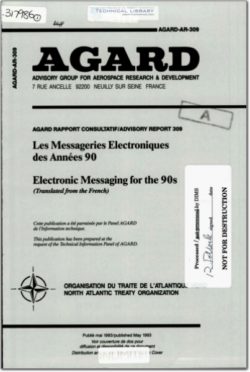
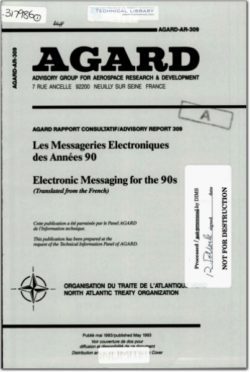
Electronic Messaging for the 90s

AGARD-AR-309 Electronic Messaging for the 90s

Information in all its forms has taken on a considerable
importance at the end of the twentieth century, in
government and administrative affairs, in companies,
associations and other organisations, and at the individual
level. A fully-fledged economy of information has
developed, with producers, distributors, consumers,
equipment manufacturing, and so on.

The means deployed are both enormous and as varied as
the "information processing" chain itself, from data
production or acquisition, to storage, processing and
distribution to the consumer in the broad sense of the
term, through to recovery of the transmitted infomiation
in a form usable by the end consumer.

In the current paper we are mainly interested in how
information circulates. In the Roman Empire and in
16th-century Europe, the foundations of political, military
and commercial power rested on the speed at which
information could travel. In those days, time was
counted in days, weeks and even months. Today we are
looking for times of the order of a second, whether it be
to transmit financial data between two distant points like
New York or Tokyo, or for strategic defense
applications.

Let us not, though, lose sight of the fact that information
flow is an integral part of a chain whose links should be
as consistent and homogeneous as possible. Moreover,
this is only one tool at the service of a series of human
activities, and it must therefore fit in with them. Yet it
is probably true that precise control of information flow
in itself generates new activities, and is bringing changes
to the extent of revolutionising certain activities.

Electronic messaging is a technique whose potential in
this context of information flow is now just beginning to
be felt, at both company and world wide level.

One important characteristic of information flow, and of
the global processing system that has developed to
support it, stems from the fact that information may or
may not be identified with the medium that transmits it.
For a handwritten letter that goes through the mail, for
example, the medium cannot be segregated from its
content. But a television picture or telephone call is
different in this respect.

FileAction
AGARD-AR-309 Electronic Messaging for the 90s.pdfDownload 

Comment On This Post

Your email address will not be published. Required fields are marked *

AGARD-AR-309

AGARD-AR-309
  • Version
  • 64 Downloads
  • 7.51 MB File Size
  • 1 File Count
  • March 8, 2016 Create Date
  • March 8, 2016 Last Updated
Scroll for Details

Electronic Messaging for the 90s

AGARD-AR-309 Electronic Messaging for the 90s

Information in all its forms has taken on a considerable
importance at the end of the twentieth century, in
government and administrative affairs, in companies,
associations and other organisations, and at the individual
level. A fully-fledged economy of information has
developed, with producers, distributors, consumers,
equipment manufacturing, and so on.

The means deployed are both enormous and as varied as
the "information processing" chain itself, from data
production or acquisition, to storage, processing and
distribution to the consumer in the broad sense of the
term, through to recovery of the transmitted infomiation
in a form usable by the end consumer.

In the current paper we are mainly interested in how
information circulates. In the Roman Empire and in
16th-century Europe, the foundations of political, military
and commercial power rested on the speed at which
information could travel. In those days, time was
counted in days, weeks and even months. Today we are
looking for times of the order of a second, whether it be
to transmit financial data between two distant points like
New York or Tokyo, or for strategic defense
applications.

Let us not, though, lose sight of the fact that information
flow is an integral part of a chain whose links should be
as consistent and homogeneous as possible. Moreover,
this is only one tool at the service of a series of human
activities, and it must therefore fit in with them. Yet it
is probably true that precise control of information flow
in itself generates new activities, and is bringing changes
to the extent of revolutionising certain activities.

Electronic messaging is a technique whose potential in
this context of information flow is now just beginning to
be felt, at both company and world wide level.

One important characteristic of information flow, and of
the global processing system that has developed to
support it, stems from the fact that information may or
may not be identified with the medium that transmits it.
For a handwritten letter that goes through the mail, for
example, the medium cannot be segregated from its
content. But a television picture or telephone call is
different in this respect.

FileAction
AGARD-AR-309 Electronic Messaging for the 90s.pdfDownload 
17,005 Documents in our Technical Library
3210538 Total Downloads

Search The Technical Library

Newest Additions

NASA-RP-1060 Subsonic Aircraft: Evolution and the Matching of Size to Performance
AA-CP-20212-001
AA-CP-20212-001
ADPO10769 Occurrence of Corrosion in Airframes
The purpose of this lecture is to provide an overview ...
MIL-STD-1759 Rivets and Rivet Type Fasteners Preferred for Design
The purpose of this book form standard is to provide ...
MIL-STD-810G Environmental Engineering Considerations and Laboratory Tests
This standard contains materiel acquisition program planning and engineering direction ...