
17,005 Documents in our Technical Library
3213471 Total Downloads

Newest Additions

NASA-RP-1060 Subsonic Aircraft: Evolution and the Matching of Size to Performance
AA-CP-20212-001
AA-CP-20212-001
ADPO10769 Occurrence of Corrosion in Airframes
The purpose of this lecture is to provide an overview ...
MIL-STD-1759 Rivets and Rivet Type Fasteners Preferred for Design
The purpose of this book form standard is to provide ...
MIL-STD-810G Environmental Engineering Considerations and Laboratory Tests
This standard contains materiel acquisition program planning and engineering direction ...

AGARD AD 744596

AGARD AD 744596
  • Version
  • 187 Downloads
  • 9.69 MB File Size
  • 1 File Count
  • March 7, 2016 Create Date
  • March 7, 2016 Last Updated
Scroll for Details

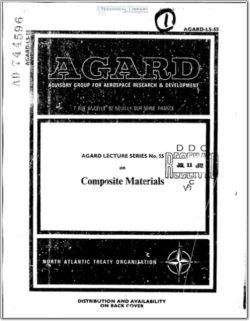
Lecture on composite materials - Application, Design and Analysis
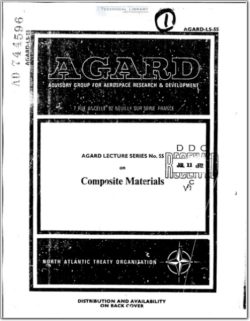
AGARD AD 744596 Lecture on composite materials

The concept of designing a material to yield a desired set of properties has re-
ceived impetus from the growing acceptance of composite materials. This utilization of
the diversity of contemporary high strength and high stiffness fibers in various struc-
tural applications has motivated a new interest in the study of relationships between
the mechanical and physical properties of composites and those of their constituents.
The aims of such studies are, first, to provide the ability to analyze the performance
of structures utilizing these heterogeneous materials. and second, to provide guidelines
for thv development of improved materials.

Inclusion in the structural design process of the material design phase has had a
significant impact upon the entire design process; particularly upon the preliminary de-
sign phase. In this preliminary design, the number of materials which may be consider-
ed for a design generally will include many for which experimental materials properties
data are not available. Thus, preliminary material selection may be based on analytical-
ly predicted properties. These analytical methods are the result of studies of the re-
lationship between effective properties of compoaites and the properties of their con—
stituents (studies which are frequently described by the misnomer 'micromechanics”).

The understanding of the relationships between the overall or average response of a com~
posite and the properties of its constituents permits the representation of the inhomo-
geneous composite by an effective homogeneous (and generally, anisotropic) material.

The properties of this homogeneous material are the effective properties of the compos-
ite: that is, they are the properties which relate the average values of the state vari-
ables in the composite. When the effective properties of a unidirectional composite have
been determined, the material may be viewed as a homogeneous anisotropic material for
many aspects of the design process.

The last decade has witnessed a significant increase in the understanding and utili-
sation of fibrous composite materials. That decade has also witnessed a much larger in-
crease in the amount of published literature in this field. The present paper provides
a brief review of the available capability for composite material design and analysis.
The aim is to provide guidance for one who seeks to become familiar with the tools re-
quired for designing fiber composite materials. The paper attempts to identify the key
concepts associated with the use of these unique materials, and to indicate source publi-
cations for detailed explanation. In addition to the publications discussed herein. there
is a valuable portion of the composites literature represented by the published collections
of papers presented at converences devoted solely to composite materials.

FileAction
AGARD AD 744596 Lecture on composite materials.pdfDownload 

Comment On This Post

Your email address will not be published. Required fields are marked *

AGARD AD 744596

AGARD AD 744596
  • Version
  • 187 Downloads
  • 9.69 MB File Size
  • 1 File Count
  • March 7, 2016 Create Date
  • March 7, 2016 Last Updated
Scroll for Details

Lecture on composite materials - Application, Design and Analysis

AGARD AD 744596 Lecture on composite materials

The concept of designing a material to yield a desired set of properties has re-
ceived impetus from the growing acceptance of composite materials. This utilization of
the diversity of contemporary high strength and high stiffness fibers in various struc-
tural applications has motivated a new interest in the study of relationships between
the mechanical and physical properties of composites and those of their constituents.
The aims of such studies are, first, to provide the ability to analyze the performance
of structures utilizing these heterogeneous materials. and second, to provide guidelines
for thv development of improved materials.

Inclusion in the structural design process of the material design phase has had a
significant impact upon the entire design process; particularly upon the preliminary de-
sign phase. In this preliminary design, the number of materials which may be consider-
ed for a design generally will include many for which experimental materials properties
data are not available. Thus, preliminary material selection may be based on analytical-
ly predicted properties. These analytical methods are the result of studies of the re-
lationship between effective properties of compoaites and the properties of their con—
stituents (studies which are frequently described by the misnomer 'micromechanics”).

The understanding of the relationships between the overall or average response of a com~
posite and the properties of its constituents permits the representation of the inhomo-
geneous composite by an effective homogeneous (and generally, anisotropic) material.

The properties of this homogeneous material are the effective properties of the compos-
ite: that is, they are the properties which relate the average values of the state vari-
ables in the composite. When the effective properties of a unidirectional composite have
been determined, the material may be viewed as a homogeneous anisotropic material for
many aspects of the design process.

The last decade has witnessed a significant increase in the understanding and utili-
sation of fibrous composite materials. That decade has also witnessed a much larger in-
crease in the amount of published literature in this field. The present paper provides
a brief review of the available capability for composite material design and analysis.
The aim is to provide guidance for one who seeks to become familiar with the tools re-
quired for designing fiber composite materials. The paper attempts to identify the key
concepts associated with the use of these unique materials, and to indicate source publi-
cations for detailed explanation. In addition to the publications discussed herein. there
is a valuable portion of the composites literature represented by the published collections
of papers presented at converences devoted solely to composite materials.

FileAction
AGARD AD 744596 Lecture on composite materials.pdfDownload 
17,005 Documents in our Technical Library
3213471 Total Downloads

Search The Technical Library

Newest Additions

NASA-RP-1060 Subsonic Aircraft: Evolution and the Matching of Size to Performance
AA-CP-20212-001
AA-CP-20212-001
ADPO10769 Occurrence of Corrosion in Airframes
The purpose of this lecture is to provide an overview ...
MIL-STD-1759 Rivets and Rivet Type Fasteners Preferred for Design
The purpose of this book form standard is to provide ...
MIL-STD-810G Environmental Engineering Considerations and Laboratory Tests
This standard contains materiel acquisition program planning and engineering direction ...