
17,005 Documents in our Technical Library
3330052 Total Downloads

Newest Additions

NASA-RP-1060 Subsonic Aircraft: Evolution and the Matching of Size to Performance
AA-CP-20212-001
AA-CP-20212-001
ADPO10769 Occurrence of Corrosion in Airframes
The purpose of this lecture is to provide an overview ...
MIL-STD-1759 Rivets and Rivet Type Fasteners Preferred for Design
The purpose of this book form standard is to provide ...
MIL-STD-810G Environmental Engineering Considerations and Laboratory Tests
This standard contains materiel acquisition program planning and engineering direction ...

NASA-TN-D-3885

NASA-TN-D-3885
  • Version
  • 238 Downloads
  • 1.39 MB File Size
  • 1 File Count
  • May 19, 2016 Create Date
  • May 19, 2016 Last Updated
Scroll for Details

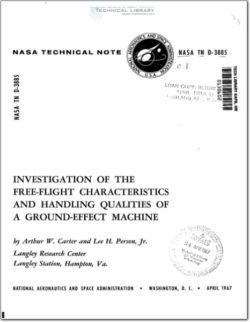
Investigation of the free flight characteristics and handling qualities of a ground effect machine
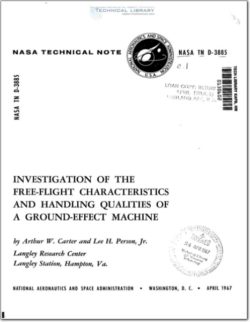
NASA-TN-D-3885 Investigation of the free flight characteristics and handling qualities of a ground effect machine
The results of an investigation of the free -flight characteristics and handling qual-
ities of an experimental manned ground-effect machine (designated GEM III) indicate that
the control system was generally poor and would be unacceptable for normal operations
over sustained periods of time. Any inherently good handling qualities were masked by
high breakout, friction and maximum control forces, excessive control free play, lack of
positive control centering, and nonlinear characteristics of the control system. The use
of collective deflection of the main nozzle vanes (integrated propulsion system) for pro-
pulsion or braking reduced an otherwise acceptable yaw control to an unacceptable level.
The maximum forward acceleration was 0.044g when operating with the integrated pro—
pulsion system and 0.100g when the separate propulsion engine was added. Pilots'
opinions indicated that the longitudinal acceleration of 0.1g was about the minimum
acceptable value. The maximum rate of deceleration or braking was 0.055g which was
about half of the minimum considered to be acceptable.
Gem III had positive longitudinal and lateral static stability during hovering. The
longitudinal and lateral damping were essentially deadbeat and there were no tendencies
toward sustained longitudinal or lateral oscillations during hovering except during
attempts to dock the vehicle when the inadequate lateral control and the time lag in the
vehicle response to control movement caused the pilot to develop inadvertent oscillations.
Directional stability increased with speed and no directional stability difficulties were
encountered up to the maximum velocity obtained, 47 feet per second (14.3 meters per
second). Operation in winds above 5 knots (2.57 meters per second) was unsatisfactory
because of the weak lateral control.
In general, GEM 111 did not appear to be suitable for operations over water. Pitch
and roll control effectiveness, longitudinal and lateral accelerations, maneuverability,
and forward speed with the integrated propulsion system were greatly reduced when com-
pared with the operation over land. When the separate propulsion engine was operating
at full power, the forward accelerations and velocity were comparable to those obtained
over land. Spray was heavy during hovering; however, visibility was satisfactory at
forward speeds above 2 knots (1 meter per second).

FileAction
NASA-TN-D-3885 Investigation of the free flight characteristics and handling qualities of a ground effect machine.pdfDownload 

Comment On This Post

Your email address will not be published. Required fields are marked *

NASA-TN-D-3885

NASA-TN-D-3885
  • Version
  • 238 Downloads
  • 1.39 MB File Size
  • 1 File Count
  • May 19, 2016 Create Date
  • May 19, 2016 Last Updated
Scroll for Details

Investigation of the free flight characteristics and handling qualities of a ground effect machine
NASA-TN-D-3885 Investigation of the free flight characteristics and handling qualities of a ground effect machine
The results of an investigation of the free -flight characteristics and handling qual-
ities of an experimental manned ground-effect machine (designated GEM III) indicate that
the control system was generally poor and would be unacceptable for normal operations
over sustained periods of time. Any inherently good handling qualities were masked by
high breakout, friction and maximum control forces, excessive control free play, lack of
positive control centering, and nonlinear characteristics of the control system. The use
of collective deflection of the main nozzle vanes (integrated propulsion system) for pro-
pulsion or braking reduced an otherwise acceptable yaw control to an unacceptable level.
The maximum forward acceleration was 0.044g when operating with the integrated pro—
pulsion system and 0.100g when the separate propulsion engine was added. Pilots'
opinions indicated that the longitudinal acceleration of 0.1g was about the minimum
acceptable value. The maximum rate of deceleration or braking was 0.055g which was
about half of the minimum considered to be acceptable.
Gem III had positive longitudinal and lateral static stability during hovering. The
longitudinal and lateral damping were essentially deadbeat and there were no tendencies
toward sustained longitudinal or lateral oscillations during hovering except during
attempts to dock the vehicle when the inadequate lateral control and the time lag in the
vehicle response to control movement caused the pilot to develop inadvertent oscillations.
Directional stability increased with speed and no directional stability difficulties were
encountered up to the maximum velocity obtained, 47 feet per second (14.3 meters per
second). Operation in winds above 5 knots (2.57 meters per second) was unsatisfactory
because of the weak lateral control.
In general, GEM 111 did not appear to be suitable for operations over water. Pitch
and roll control effectiveness, longitudinal and lateral accelerations, maneuverability,
and forward speed with the integrated propulsion system were greatly reduced when com-
pared with the operation over land. When the separate propulsion engine was operating
at full power, the forward accelerations and velocity were comparable to those obtained
over land. Spray was heavy during hovering; however, visibility was satisfactory at
forward speeds above 2 knots (1 meter per second).

FileAction
NASA-TN-D-3885 Investigation of the free flight characteristics and handling qualities of a ground effect machine.pdfDownload 
17,005 Documents in our Technical Library
3330052 Total Downloads

Search The Technical Library

Newest Additions

NASA-RP-1060 Subsonic Aircraft: Evolution and the Matching of Size to Performance
AA-CP-20212-001
AA-CP-20212-001
ADPO10769 Occurrence of Corrosion in Airframes
The purpose of this lecture is to provide an overview ...
MIL-STD-1759 Rivets and Rivet Type Fasteners Preferred for Design
The purpose of this book form standard is to provide ...
MIL-STD-810G Environmental Engineering Considerations and Laboratory Tests
This standard contains materiel acquisition program planning and engineering direction ...