17,005 Documents in our Technical Library
3210068 Total Downloads

Newest Additions

NASA-RP-1060 Subsonic Aircraft: Evolution and the Matching of Size to Performance
AA-CP-20212-001
AA-CP-20212-001
ADPO10769 Occurrence of Corrosion in Airframes
The purpose of this lecture is to provide an overview ...
MIL-STD-1759 Rivets and Rivet Type Fasteners Preferred for Design
The purpose of this book form standard is to provide ...
MIL-STD-810G Environmental Engineering Considerations and Laboratory Tests
This standard contains materiel acquisition program planning and engineering direction ...

AGARD-LS-187

AGARD-LS-187
  • Version
  • 179 Downloads
  • 5.15 MB File Size
  • 1 File Count
  • April 26, 2016 Create Date
  • April 26, 2016 Last Updated
Scroll for Details

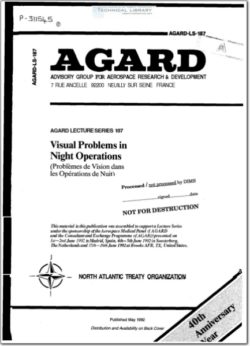
Visual Problems in Night Operations
AGARD-LS-187 Visual Problems in Night Operations
Strategists have long sought to exploit the
night in military operations, not only to avoid
detection and as a means to defeat visually or
optically aimed weapons, but also to deny the enemy
an opportunity to rest or resupply his troops.
With the advent of practical and effective imaging
devices, true night war fighting capability has at
last become a reality (as demonstrated in the
recent Gulf War). It is safe to assume that night
military operations will receive even more emphasis
in the uture. Current aviation activities range
from basic single pilot helicopter operations with
night vision goggles (NVGs) to complex missions
utilizing a mix of highly sophisticated aircraft
with multiple sensors, precise navigational
capabilities and advanced weapons delivery systems.
The first "imaging device" employed in
military aviation was a radar bombsight used
extensively during World War II for strategic
bombing. Quite crude by present standards, it did
permit a non—precision delivery of bombs at night,
or through cloud cover. Aircraft interception
during darkness also began in World War II with the
inception of air—to—air radar systems, which
despite their limited capabilities, were used by
both the Allies and the Luftwaffe with modest
success.
Since the Second World War, radar systems,
both air-to—ground and air—to—air, have been
steadily improved and employed in a wide variety of
strateqic and tactical aircraft. Hiohlv
sophisticated radar systems are responsible for the
majority of our present day all—weather
capabi1ities.
The earliest devices which provided night
vision" were the infrared (IR) sniper scopes, also
of WW 11. These devices, despite their various
limitations, afforded the military a more or less
covert night imaging capability for the first time.
They had the disadvantage of requiring an infrared
source for illumination (irradiation). This not
only limited their effective range, but also made
them easily detectable by an adversary equipped
with a similar device.

FileAction
AGARD-LS-187 Visual Problems in Night Operations.pdfDownload 

Comment On This Post

Your email address will not be published. Required fields are marked *

AGARD-LS-187

AGARD-LS-187
  • Version
  • 179 Downloads
  • 5.15 MB File Size
  • 1 File Count
  • April 26, 2016 Create Date
  • April 26, 2016 Last Updated
Scroll for Details

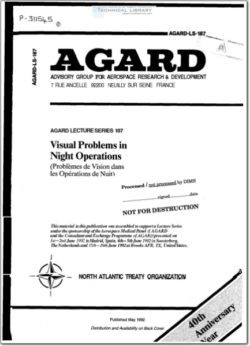
Visual Problems in Night Operations
AGARD-LS-187 Visual Problems in Night Operations
Strategists have long sought to exploit the
night in military operations, not only to avoid
detection and as a means to defeat visually or
optically aimed weapons, but also to deny the enemy
an opportunity to rest or resupply his troops.
With the advent of practical and effective imaging
devices, true night war fighting capability has at
last become a reality (as demonstrated in the
recent Gulf War). It is safe to assume that night
military operations will receive even more emphasis
in the uture. Current aviation activities range
from basic single pilot helicopter operations with
night vision goggles (NVGs) to complex missions
utilizing a mix of highly sophisticated aircraft
with multiple sensors, precise navigational
capabilities and advanced weapons delivery systems.
The first "imaging device" employed in
military aviation was a radar bombsight used
extensively during World War II for strategic
bombing. Quite crude by present standards, it did
permit a non—precision delivery of bombs at night,
or through cloud cover. Aircraft interception
during darkness also began in World War II with the
inception of air—to—air radar systems, which
despite their limited capabilities, were used by
both the Allies and the Luftwaffe with modest
success.
Since the Second World War, radar systems,
both air-to—ground and air—to—air, have been
steadily improved and employed in a wide variety of
strateqic and tactical aircraft. Hiohlv
sophisticated radar systems are responsible for the
majority of our present day all—weather
capabi1ities.
The earliest devices which provided night
vision" were the infrared (IR) sniper scopes, also
of WW 11. These devices, despite their various
limitations, afforded the military a more or less
covert night imaging capability for the first time.
They had the disadvantage of requiring an infrared
source for illumination (irradiation). This not
only limited their effective range, but also made
them easily detectable by an adversary equipped
with a similar device.

FileAction
AGARD-LS-187 Visual Problems in Night Operations.pdfDownload 
17,005 Documents in our Technical Library
3210068 Total Downloads

Search The Technical Library

Newest Additions

NASA-RP-1060 Subsonic Aircraft: Evolution and the Matching of Size to Performance
AA-CP-20212-001
AA-CP-20212-001
ADPO10769 Occurrence of Corrosion in Airframes
The purpose of this lecture is to provide an overview ...
MIL-STD-1759 Rivets and Rivet Type Fasteners Preferred for Design
The purpose of this book form standard is to provide ...
MIL-STD-810G Environmental Engineering Considerations and Laboratory Tests
This standard contains materiel acquisition program planning and engineering direction ...