
17,005 Documents in our Technical Library
3207757 Total Downloads

Newest Additions

NASA-RP-1060 Subsonic Aircraft: Evolution and the Matching of Size to Performance
AA-CP-20212-001
AA-CP-20212-001
ADPO10769 Occurrence of Corrosion in Airframes
The purpose of this lecture is to provide an overview ...
MIL-STD-1759 Rivets and Rivet Type Fasteners Preferred for Design
The purpose of this book form standard is to provide ...
MIL-STD-810G Environmental Engineering Considerations and Laboratory Tests
This standard contains materiel acquisition program planning and engineering direction ...

AGARD-LS-184

AGARD-LS-184
  • Version
  • 215 Downloads
  • 13.43 MB File Size
  • 1 File Count
  • April 25, 2016 Create Date
  • April 25, 2016 Last Updated
Scroll for Details

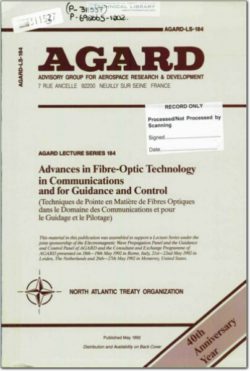
Advances in Fibre Optic Technology in Communications and for Guidance and Control
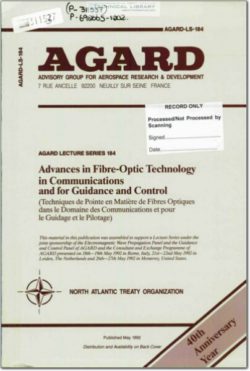
AGARD-LS-184 Advances in Fibre Optic Technology in Communications and for Guidance and Control
The performance characteristics of state-af-the-
art semiconductor lasers for fiber telecommunication
systems are reviewed. Modulation speed. intensity
noise, single-frequency line width, and tunability are
addressed. In addition. recent results concerning the
same characteristics in single-frequency, tunable.
fiber lasers are reviewed and compared with the
semiconductor laser.
Semiconductor lasers have now found their way
into several large commercial markets. Brightness.
diffraction-limited spot size. power efficiency, reli-
ability, and cost per component are the overriding
concerns in most of these applications. This includes
laser printers. compact disc players, and their use as
solid-state laser pump sources. A sole exception is
their application to fiber 0 tie telecommunication
systems. Research and p net-development activi-
ties in this area continue to set impressive device per-
formance records concerning spectral purity, tun-
ability. modulation speed. and relative intensity
noise levels. As a result of this effort commercial
semiconductor lasers are nearly ideal in terms of
their physical properties. Their intensity noise spec-
tra and short-term frequency stabilitKaaure governed
almost exclusively by quantum mec 'cal effects.
The tuning range rn monolithic devices has recently
been extended to encompass most of the available
semiconductor gain band width and direct modula-
tion speed has entered the millimeter-wave band.
In parallel with the above developments which
emphasize their use as sources and local oscillators.
the rapid development of traveling-wave optical-fiber
amplifiers based on the rare-earth impurity erbium
has created a new role in fiber systems for the semi-
conductor laser. As early as 1964 Koester and
Snitzer demonstrated the first traveling wave ampli-
fier as well as fiber laser based on neodymium
mm glass (1). It was not until 1985. however. that
experiments by researchers at Southhampton
University ignited new and sustained interest in rare-
earth doped fibers (in particular. erbium-doped
fibers) as a viable and practical amplification
medium (2). Central to the success of these remark-
able amplifiers has been the ability to efficiently
pump erbium-doped fiber at wavelengths attainable
with semiconductor lasers.

FileAction
AGARD-LS-184 Advances in Fibre Optic Technology in Communications and for Guidance and Control.pdfDownload 

Comment On This Post

Your email address will not be published. Required fields are marked *

AGARD-LS-184

AGARD-LS-184
  • Version
  • 215 Downloads
  • 13.43 MB File Size
  • 1 File Count
  • April 25, 2016 Create Date
  • April 25, 2016 Last Updated
Scroll for Details

Advances in Fibre Optic Technology in Communications and for Guidance and Control
AGARD-LS-184 Advances in Fibre Optic Technology in Communications and for Guidance and Control
The performance characteristics of state-af-the-
art semiconductor lasers for fiber telecommunication
systems are reviewed. Modulation speed. intensity
noise, single-frequency line width, and tunability are
addressed. In addition. recent results concerning the
same characteristics in single-frequency, tunable.
fiber lasers are reviewed and compared with the
semiconductor laser.
Semiconductor lasers have now found their way
into several large commercial markets. Brightness.
diffraction-limited spot size. power efficiency, reli-
ability, and cost per component are the overriding
concerns in most of these applications. This includes
laser printers. compact disc players, and their use as
solid-state laser pump sources. A sole exception is
their application to fiber 0 tie telecommunication
systems. Research and p net-development activi-
ties in this area continue to set impressive device per-
formance records concerning spectral purity, tun-
ability. modulation speed. and relative intensity
noise levels. As a result of this effort commercial
semiconductor lasers are nearly ideal in terms of
their physical properties. Their intensity noise spec-
tra and short-term frequency stabilitKaaure governed
almost exclusively by quantum mec 'cal effects.
The tuning range rn monolithic devices has recently
been extended to encompass most of the available
semiconductor gain band width and direct modula-
tion speed has entered the millimeter-wave band.
In parallel with the above developments which
emphasize their use as sources and local oscillators.
the rapid development of traveling-wave optical-fiber
amplifiers based on the rare-earth impurity erbium
has created a new role in fiber systems for the semi-
conductor laser. As early as 1964 Koester and
Snitzer demonstrated the first traveling wave ampli-
fier as well as fiber laser based on neodymium
mm glass (1). It was not until 1985. however. that
experiments by researchers at Southhampton
University ignited new and sustained interest in rare-
earth doped fibers (in particular. erbium-doped
fibers) as a viable and practical amplification
medium (2). Central to the success of these remark-
able amplifiers has been the ability to efficiently
pump erbium-doped fiber at wavelengths attainable
with semiconductor lasers.

FileAction
AGARD-LS-184 Advances in Fibre Optic Technology in Communications and for Guidance and Control.pdfDownload 
17,005 Documents in our Technical Library
3207757 Total Downloads

Search The Technical Library

Newest Additions

NASA-RP-1060 Subsonic Aircraft: Evolution and the Matching of Size to Performance
AA-CP-20212-001
AA-CP-20212-001
ADPO10769 Occurrence of Corrosion in Airframes
The purpose of this lecture is to provide an overview ...
MIL-STD-1759 Rivets and Rivet Type Fasteners Preferred for Design
The purpose of this book form standard is to provide ...
MIL-STD-810G Environmental Engineering Considerations and Laboratory Tests
This standard contains materiel acquisition program planning and engineering direction ...