
17,005 Documents in our Technical Library
3249537 Total Downloads

Newest Additions

NASA-RP-1060 Subsonic Aircraft: Evolution and the Matching of Size to Performance
AA-CP-20212-001
AA-CP-20212-001
ADPO10769 Occurrence of Corrosion in Airframes
The purpose of this lecture is to provide an overview ...
MIL-STD-1759 Rivets and Rivet Type Fasteners Preferred for Design
The purpose of this book form standard is to provide ...
MIL-STD-810G Environmental Engineering Considerations and Laboratory Tests
This standard contains materiel acquisition program planning and engineering direction ...

naca-tn-1728

  • Version
  • 123 Downloads
  • 1.23 MB File Size
  • 1 File Count
  • December 6, 2016 Create Date
  • December 6, 2016 Last Updated
Scroll for Details

National Advisory Committee for Aeronautics, Technical Notes - Shear Lag in Axially Loaded Panels
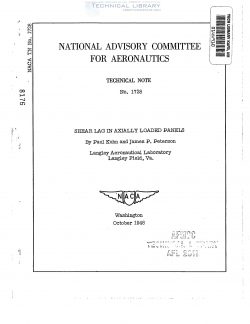
naca-tn-1728-shear-lag-in-axially-loaded-panels-1

The method of calculating shear—lag effects in axially loaded panels
by means of the previously developed concept of the "substitute singleh
stringer panel" is simplified by an empirical expression for the width of
the substitute panel which eliminates the need for successive approxima—
tions. For simple types of single—stringer panels, a theory not dependent
on the assumption of infinite transverse stiffness is developed that can
be used to estimate the effect of transverse stiffness on the stresses in
practical panels. Strain measurements on five panels indicate that the
theory should be adequate for design purposes and that the effect of
transverse stiffness may be appreciable.

The problem of introducing concentrated forces at one end of a
longitudinally stiffened panel is a fundamental one in the shear-lag
theory and has been treated by a number of authors. The solutions
obtained by standard methods of analysis are quite cumbersome even for
panels of constant cross section, and most of them.are not applicable
to the practical case of panels with arbitrarily variable cross section.
Moreover, almost all these solutions are based on the assumption of
infinite transverse stiffness of the panel; this assumption leads to
the result that the maximum shear stress is infinite when there are no
discrete stringers attached to the sheet, a result which is so much in
error as to be useless to the stress analyst. For a finite number of
stringers, the error becomes finite but is still appreciable in the usual
range of stringer numbers.

In an effort to provide a practical method of shear—lag analysis,
an apprdximate "substitute single—stringer method" was presented in
reference 1. Although this method is also based on the assumption of
infinite transverse stiffness, it does not give infinite shear stresses
as the mathematically more rigorous methods do; in fact, the agreement
between this theory and early tests was found to be fairly good (refer—
ence 2). Further study of the problem indicated, however, that some
investigation of the influence of finite transverse stiffness was
desirable. The results of this investigation are presented in this
paper.

FileAction
naca-tn-1728 Shear Lag in Axially Loaded Panels.pdfDownload 

Comment On This Post

Your email address will not be published. Required fields are marked *

naca-tn-1728

  • Version
  • 123 Downloads
  • 1.23 MB File Size
  • 1 File Count
  • December 6, 2016 Create Date
  • December 6, 2016 Last Updated
Scroll for Details

National Advisory Committee for Aeronautics, Technical Notes - Shear Lag in Axially Loaded Panels

naca-tn-1728-shear-lag-in-axially-loaded-panels-1

The method of calculating shear—lag effects in axially loaded panels
by means of the previously developed concept of the "substitute singleh
stringer panel" is simplified by an empirical expression for the width of
the substitute panel which eliminates the need for successive approxima—
tions. For simple types of single—stringer panels, a theory not dependent
on the assumption of infinite transverse stiffness is developed that can
be used to estimate the effect of transverse stiffness on the stresses in
practical panels. Strain measurements on five panels indicate that the
theory should be adequate for design purposes and that the effect of
transverse stiffness may be appreciable.

The problem of introducing concentrated forces at one end of a
longitudinally stiffened panel is a fundamental one in the shear-lag
theory and has been treated by a number of authors. The solutions
obtained by standard methods of analysis are quite cumbersome even for
panels of constant cross section, and most of them.are not applicable
to the practical case of panels with arbitrarily variable cross section.
Moreover, almost all these solutions are based on the assumption of
infinite transverse stiffness of the panel; this assumption leads to
the result that the maximum shear stress is infinite when there are no
discrete stringers attached to the sheet, a result which is so much in
error as to be useless to the stress analyst. For a finite number of
stringers, the error becomes finite but is still appreciable in the usual
range of stringer numbers.

In an effort to provide a practical method of shear—lag analysis,
an apprdximate "substitute single—stringer method" was presented in
reference 1. Although this method is also based on the assumption of
infinite transverse stiffness, it does not give infinite shear stresses
as the mathematically more rigorous methods do; in fact, the agreement
between this theory and early tests was found to be fairly good (refer—
ence 2). Further study of the problem indicated, however, that some
investigation of the influence of finite transverse stiffness was
desirable. The results of this investigation are presented in this
paper.

FileAction
naca-tn-1728 Shear Lag in Axially Loaded Panels.pdfDownload 
17,005 Documents in our Technical Library
3249537 Total Downloads

Search The Technical Library

Newest Additions

NASA-RP-1060 Subsonic Aircraft: Evolution and the Matching of Size to Performance
AA-CP-20212-001
AA-CP-20212-001
ADPO10769 Occurrence of Corrosion in Airframes
The purpose of this lecture is to provide an overview ...
MIL-STD-1759 Rivets and Rivet Type Fasteners Preferred for Design
The purpose of this book form standard is to provide ...
MIL-STD-810G Environmental Engineering Considerations and Laboratory Tests
This standard contains materiel acquisition program planning and engineering direction ...