
17,005 Documents in our Technical Library
3420530 Total Downloads

Newest Additions

NASA-RP-1060 Subsonic Aircraft: Evolution and the Matching of Size to Performance
AA-CP-20212-001
AA-CP-20212-001
ADPO10769 Occurrence of Corrosion in Airframes
The purpose of this lecture is to provide an overview ...
MIL-STD-1759 Rivets and Rivet Type Fasteners Preferred for Design
The purpose of this book form standard is to provide ...
MIL-STD-810G Environmental Engineering Considerations and Laboratory Tests
This standard contains materiel acquisition program planning and engineering direction ...

naca-tn-525

  • Version
  • 259 Downloads
  • 1,021.82 KB File Size
  • 1 File Count
  • November 25, 2016 Create Date
  • November 25, 2016 Last Updated
Scroll for Details

National Advisory Committee for Aeronautics, Technical Notes - The Aerodynamic Drag of Flying Boat Hull Models as Measured in the NACA 20 Foot Wind Tunnel - I
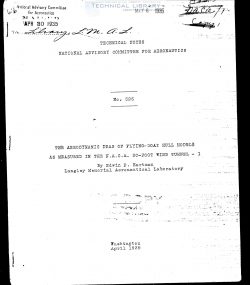
naca-tn-525-the-aerodynamic-drag-of-flying-boat-hull-models-as-measured-in-the-naca-20-foot-wind-tunnel-i-1

Measurements of aerodynamic drag have been made in
the 20~foot wind tunnel on a representative group of 11
flying—boat hull models. The models were originally con-
structed for the N.A.C.A. tank and the results of tank
tests on 9 of them have already been published.

Four of the models were modified to investigate the
effect of variations in over-all height, contour of deck,
depth of step, angle of afterbody heel, and the addition
of spray strips and Windshields.

The results of these tests, which cover a pitch—angle
range from ~50 to 10°, are presented in a form suitable
for use in performance calculations and for design pur—
poses.

The scarcity of aerodynamic drag data on flying—boat
hulls has been brought to the attention of the N.A.C.A.
through repeated requests for such data. At the present
time practically all of the data on the aerodynamic char-
acteristics of flying~boat hull models that have been pub—
lished are to be found in reference 1. The tests report~
ed therein were made on models of which the greatest num~
ber are at present obsolete and of which the dimensions
were less than one half those of the models in the pres~
ent tests.

The present tests were greatly facilitated by using
the models that had been constructed for hydrodynamic re»
search in the N.A.O.A. tank. These models formed a repw
resentative group of recent hull lines and were of such
size as to permit a Reynolds Number (based on hull length)
of about 7,500,000 to be obtained.

The main purpose of this investigation is to make
available to the designer useful information with regard
to the aerodynamic drag of various types of flying~boat
hull models. The present report is the first in a series
covering an investigation in this field. Through close
cooperation between the hydrodynamics and aerodynamics
divisions it is hoped'that results leading to improvements
in hull design may be obtained.

FileAction
naca-tn-525 The Aerodynamic Drag of Flying Boat Hull Models as Measured in the NACA 20 Foot Wind Tunnel - I.pdfDownload 

Comment On This Post

Your email address will not be published. Required fields are marked *

naca-tn-525

  • Version
  • 259 Downloads
  • 1,021.82 KB File Size
  • 1 File Count
  • November 25, 2016 Create Date
  • November 25, 2016 Last Updated
Scroll for Details

National Advisory Committee for Aeronautics, Technical Notes - The Aerodynamic Drag of Flying Boat Hull Models as Measured in the NACA 20 Foot Wind Tunnel - I

naca-tn-525-the-aerodynamic-drag-of-flying-boat-hull-models-as-measured-in-the-naca-20-foot-wind-tunnel-i-1

Measurements of aerodynamic drag have been made in
the 20~foot wind tunnel on a representative group of 11
flying—boat hull models. The models were originally con-
structed for the N.A.C.A. tank and the results of tank
tests on 9 of them have already been published.

Four of the models were modified to investigate the
effect of variations in over-all height, contour of deck,
depth of step, angle of afterbody heel, and the addition
of spray strips and Windshields.

The results of these tests, which cover a pitch—angle
range from ~50 to 10°, are presented in a form suitable
for use in performance calculations and for design pur—
poses.

The scarcity of aerodynamic drag data on flying—boat
hulls has been brought to the attention of the N.A.C.A.
through repeated requests for such data. At the present
time practically all of the data on the aerodynamic char-
acteristics of flying~boat hull models that have been pub—
lished are to be found in reference 1. The tests report~
ed therein were made on models of which the greatest num~
ber are at present obsolete and of which the dimensions
were less than one half those of the models in the pres~
ent tests.

The present tests were greatly facilitated by using
the models that had been constructed for hydrodynamic re»
search in the N.A.O.A. tank. These models formed a repw
resentative group of recent hull lines and were of such
size as to permit a Reynolds Number (based on hull length)
of about 7,500,000 to be obtained.

The main purpose of this investigation is to make
available to the designer useful information with regard
to the aerodynamic drag of various types of flying~boat
hull models. The present report is the first in a series
covering an investigation in this field. Through close
cooperation between the hydrodynamics and aerodynamics
divisions it is hoped'that results leading to improvements
in hull design may be obtained.

FileAction
naca-tn-525 The Aerodynamic Drag of Flying Boat Hull Models as Measured in the NACA 20 Foot Wind Tunnel - I.pdfDownload 
17,005 Documents in our Technical Library
3420530 Total Downloads

Search The Technical Library

Newest Additions

NASA-RP-1060 Subsonic Aircraft: Evolution and the Matching of Size to Performance
AA-CP-20212-001
AA-CP-20212-001
ADPO10769 Occurrence of Corrosion in Airframes
The purpose of this lecture is to provide an overview ...
MIL-STD-1759 Rivets and Rivet Type Fasteners Preferred for Design
The purpose of this book form standard is to provide ...
MIL-STD-810G Environmental Engineering Considerations and Laboratory Tests
This standard contains materiel acquisition program planning and engineering direction ...

Popular Items