

17,005 Documents in our Technical Library
3262391 Total Downloads

Newest Additions

NASA-RP-1060 Subsonic Aircraft: Evolution and the Matching of Size to Performance
AA-CP-20212-001
AA-CP-20212-001
ADPO10769 Occurrence of Corrosion in Airframes
The purpose of this lecture is to provide an overview ...
MIL-STD-1759 Rivets and Rivet Type Fasteners Preferred for Design
The purpose of this book form standard is to provide ...
MIL-STD-810G Environmental Engineering Considerations and Laboratory Tests
This standard contains materiel acquisition program planning and engineering direction ...

naca-report-1045

naca-report-1045
  • Version
  • 228 Downloads
  • 1.06 MB File Size
  • 1 File Count
  • September 1, 2016 Create Date
  • September 1, 2016 Last Updated
Scroll for Details

National Advisory Committee for Aeronautics, Report - Supersonic Flow Around Circular Cones at Angles of Attack
naca-report-1045 Supersonic Flow Around Circular Cones at Angles of Attack-1

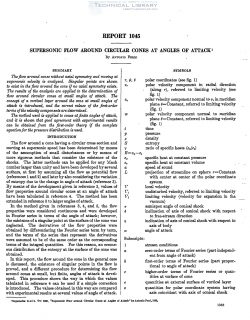
The flow around cones without axial symmetry and moving at
supersonic velocity is analyzed. Singular points are shown
to exist in the flow around the cone if no will symmetry exists.
The results of the analysis are applied to the determination of
flow around circular cones at small angles of attack. The
concept of a cortical layer around the cone at small angles of
attack is introduced, and the correct values of the first-order
terms of the velocity components are determined.

flhe method used is applied to cones at finite angles of attack,
and it is shown that good- agreement with experimental results
can be obtained from the first-order theory if the complete
eguationfor the pressure distribution is used.

The flow around a cone having a circular cross section and
moving at supersonic speed has been determined by means
of the assumption of small disturbances or by means of
more rigorous methods that consider the existence of the
shocks. The latter methods can be applied for any Mach
number larger than unity and have been developed by several
authors, at first by assuming all the flow as potential flow
(references 1 and 2) and later by also considering the variation
of entropy due to the change in angle of attack (reference 3).

By means of the development given in reference 3, values of
flow properties around circular cones at an angle of attack
have been tabulated in reference 4. The method has been
extended in reference 5 to larger angles of attack.

In the method given in references 3, 4,; and 5, the flow
properties were considered continuous and were developed
in Fourier series in terms of the angle of attack; however,
the existence of a singular point at the surface of the cone was
neglected The derivatives of the 'flow properties were
obtained by differentiating the Fourier series term by term,
and the terms of the series that represent the derivatives
were assumed to be of the same order as the corresponding
terms of the integral quantities. For this reason, an errone-
ous distribution of the entropy at the surface of the cone was
obtained.

FileAction
naca-report-1045 Supersonic Flow Around Circular Cones at Angles of Attack.pdfDownload 

Comment On This Post

Your email address will not be published. Required fields are marked *

naca-report-1045

naca-report-1045
  • Version
  • 228 Downloads
  • 1.06 MB File Size
  • 1 File Count
  • September 1, 2016 Create Date
  • September 1, 2016 Last Updated
Scroll for Details

National Advisory Committee for Aeronautics, Report - Supersonic Flow Around Circular Cones at Angles of Attack

naca-report-1045 Supersonic Flow Around Circular Cones at Angles of Attack-1

The flow around cones without axial symmetry and moving at
supersonic velocity is analyzed. Singular points are shown
to exist in the flow around the cone if no will symmetry exists.
The results of the analysis are applied to the determination of
flow around circular cones at small angles of attack. The
concept of a cortical layer around the cone at small angles of
attack is introduced, and the correct values of the first-order
terms of the velocity components are determined.

flhe method used is applied to cones at finite angles of attack,
and it is shown that good- agreement with experimental results
can be obtained from the first-order theory if the complete
eguationfor the pressure distribution is used.

The flow around a cone having a circular cross section and
moving at supersonic speed has been determined by means
of the assumption of small disturbances or by means of
more rigorous methods that consider the existence of the
shocks. The latter methods can be applied for any Mach
number larger than unity and have been developed by several
authors, at first by assuming all the flow as potential flow
(references 1 and 2) and later by also considering the variation
of entropy due to the change in angle of attack (reference 3).

By means of the development given in reference 3, values of
flow properties around circular cones at an angle of attack
have been tabulated in reference 4. The method has been
extended in reference 5 to larger angles of attack.

In the method given in references 3, 4,; and 5, the flow
properties were considered continuous and were developed
in Fourier series in terms of the angle of attack; however,
the existence of a singular point at the surface of the cone was
neglected The derivatives of the 'flow properties were
obtained by differentiating the Fourier series term by term,
and the terms of the series that represent the derivatives
were assumed to be of the same order as the corresponding
terms of the integral quantities. For this reason, an errone-
ous distribution of the entropy at the surface of the cone was
obtained.

FileAction
naca-report-1045 Supersonic Flow Around Circular Cones at Angles of Attack.pdfDownload 
17,005 Documents in our Technical Library
3262391 Total Downloads

Search The Technical Library

Newest Additions

NASA-RP-1060 Subsonic Aircraft: Evolution and the Matching of Size to Performance
AA-CP-20212-001
AA-CP-20212-001
ADPO10769 Occurrence of Corrosion in Airframes
The purpose of this lecture is to provide an overview ...
MIL-STD-1759 Rivets and Rivet Type Fasteners Preferred for Design
The purpose of this book form standard is to provide ...
MIL-STD-810G Environmental Engineering Considerations and Laboratory Tests
This standard contains materiel acquisition program planning and engineering direction ...