
17,005 Documents in our Technical Library
3544809 Total Downloads

Newest Additions

NASA-RP-1060 Subsonic Aircraft: Evolution and the Matching of Size to Performance
AA-CP-20212-001
AA-CP-20212-001
ADPO10769 Occurrence of Corrosion in Airframes
The purpose of this lecture is to provide an overview ...
MIL-STD-1759 Rivets and Rivet Type Fasteners Preferred for Design
The purpose of this book form standard is to provide ...
MIL-STD-810G Environmental Engineering Considerations and Laboratory Tests
This standard contains materiel acquisition program planning and engineering direction ...

naca-report-719

naca-report-719
  • Version
  • 218 Downloads
  • 1.20 MB File Size
  • 1 File Count
  • August 30, 2016 Create Date
  • August 30, 2016 Last Updated
▼ Scroll for Details ▼

National Advisory Committee for Aeronautics, Report - Problem Cooling an Air Cooled Cylinder on an Aircraft Engine
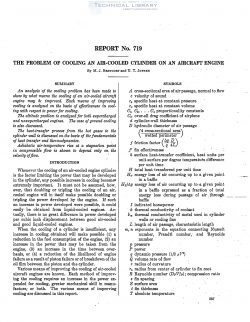
naca-report-719 The Problem Cooling an Air Cooled Cylinder on an Aircraft Engine-1

An analysis ‘of the cooling problem has been made to
show by what means the cooling of an air-cooled aircraft
engine may be improved. Each means of improving
cooling is analyzed on the basis of effectiveness in cool-
ing with respect to power for cooling.

The altitude problem is analyzed for both supercharged
and unsupercharged engines. Elbe case of ground cooling
is also discussed.

The heat-transfer process from the hot gases to the
cylinder wall is discussed on the basis of the fundamentals
of heat transfer and thermodynamics

Adiabatic air-teniperature rise at a stagnation point
in compressible flow is shown to depend only on the
relocity of flow

Whenever the cooling of an air—cooled engine cylinder
is the factor limiting the power that may be developed
in the cylinder, any possible increase in cooling becomes
extremely important. It must net be assumed, how_
ever, that doubling or tripling the cooling of an air.
cooled engine will in itself make possible doubling or
tripling the power developed by the engine. If such
an increase in power developed were possible, it could
easily be obtained from liquid—cooled engines. Ac-
tually, there is no great difl‘erence in power developed
per cubic inch displacement between good air—cooled
and good liquid-cooled engines.

When the cooling of a cylinder is insufiicient, any
increase in cooling obtained will make possible (1) a
reduction in the fuel consumption of the engine, (2) an
increase in the power that may be taken from the
engine, (3) an increase in the time between over-
hauls, or (4) a reduction of the likelihood of'engine
failure as a result of piston failure or of breakdown of the
oil film between the piston and the cylinder.

Various means of improving the cooling of air-cooled
aircraft engines are known. Each method of improv—
ing the cooling requires an increase in the power ex-
pended for cooling, greater mechanical skill in manu-
facture; or both. The various means of improving
cooling are discussed in this report.

FileAction
naca-report-719 The Problem Cooling an Air Cooled Cylinder on an Aircraft Engine.pdfDownload 

Comment On This Post

Your email address will not be published. Required fields are marked *

naca-report-719

naca-report-719
  • Version
  • 218 Downloads
  • 1.20 MB File Size
  • 1 File Count
  • August 30, 2016 Create Date
  • August 30, 2016 Last Updated
▼ Scroll for Details ▼

National Advisory Committee for Aeronautics, Report - Problem Cooling an Air Cooled Cylinder on an Aircraft Engine

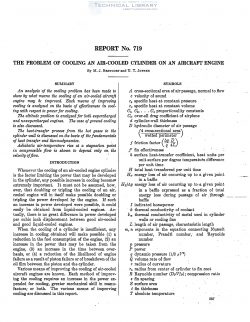
naca-report-719 The Problem Cooling an Air Cooled Cylinder on an Aircraft Engine-1

An analysis ‘of the cooling problem has been made to
show by what means the cooling of an air-cooled aircraft
engine may be improved. Each means of improving
cooling is analyzed on the basis of effectiveness in cool-
ing with respect to power for cooling.

The altitude problem is analyzed for both supercharged
and unsupercharged engines. Elbe case of ground cooling
is also discussed.

The heat-transfer process from the hot gases to the
cylinder wall is discussed on the basis of the fundamentals
of heat transfer and thermodynamics

Adiabatic air-teniperature rise at a stagnation point
in compressible flow is shown to depend only on the
relocity of flow

Whenever the cooling of an air—cooled engine cylinder
is the factor limiting the power that may be developed
in the cylinder, any possible increase in cooling becomes
extremely important. It must net be assumed, how_
ever, that doubling or tripling the cooling of an air.
cooled engine will in itself make possible doubling or
tripling the power developed by the engine. If such
an increase in power developed were possible, it could
easily be obtained from liquid—cooled engines. Ac-
tually, there is no great difl‘erence in power developed
per cubic inch displacement between good air—cooled
and good liquid-cooled engines.

When the cooling of a cylinder is insufiicient, any
increase in cooling obtained will make possible (1) a
reduction in the fuel consumption of the engine, (2) an
increase in the power that may be taken from the
engine, (3) an increase in the time between over-
hauls, or (4) a reduction of the likelihood of'engine
failure as a result of piston failure or of breakdown of the
oil film between the piston and the cylinder.

Various means of improving the cooling of air-cooled
aircraft engines are known. Each method of improv—
ing the cooling requires an increase in the power ex-
pended for cooling, greater mechanical skill in manu-
facture; or both. The various means of improving
cooling are discussed in this report.

FileAction
naca-report-719 The Problem Cooling an Air Cooled Cylinder on an Aircraft Engine.pdfDownload 
17,005 Documents in our Technical Library
3544809 Total Downloads

Search The Technical Library

Newest Additions

NASA-RP-1060 Subsonic Aircraft: Evolution and the Matching of Size to Performance
AA-CP-20212-001
AA-CP-20212-001
ADPO10769 Occurrence of Corrosion in Airframes
The purpose of this lecture is to provide an overview ...
MIL-STD-1759 Rivets and Rivet Type Fasteners Preferred for Design
The purpose of this book form standard is to provide ...
MIL-STD-810G Environmental Engineering Considerations and Laboratory Tests
This standard contains materiel acquisition program planning and engineering direction ...