
17,005 Documents in our Technical Library
3249768 Total Downloads

Newest Additions

NASA-RP-1060 Subsonic Aircraft: Evolution and the Matching of Size to Performance
AA-CP-20212-001
AA-CP-20212-001
ADPO10769 Occurrence of Corrosion in Airframes
The purpose of this lecture is to provide an overview ...
MIL-STD-1759 Rivets and Rivet Type Fasteners Preferred for Design
The purpose of this book form standard is to provide ...
MIL-STD-810G Environmental Engineering Considerations and Laboratory Tests
This standard contains materiel acquisition program planning and engineering direction ...

naca-report-464

naca-report-464
  • Version
  • 241 Downloads
  • 965.80 KB File Size
  • 1 File Count
  • August 26, 2016 Create Date
  • August 26, 2016 Last Updated
Scroll for Details

National Advisory Committee for Aeronautics, Report - Negative Thrust and Torque Characteristics of an Adjustable Pitch Metal Propeller
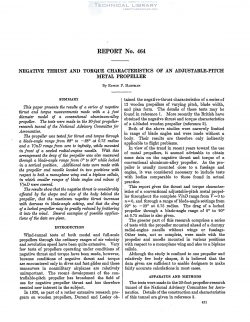
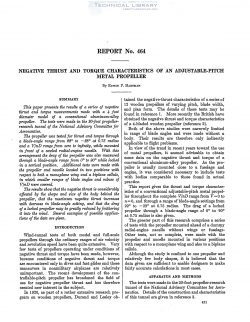
naca-report-464 Negative Thrust and Torque Characteristics of an Adjustable Pitch Metal Propeller-1
This paper presents the results of a series of negative
thrust and torque measurements made with a 4 foot
diameter model of a conventional aluminum—alloy
propeller. The tests were made in the 20-foot propeller-
research tunnel of the National Advisory Committee for
Aeronautics.
The propeller was tested for thrust and torque through
a blade-angle range from 22° to ~23° at 0.75 radius
and a V/nD range from zero to infinity, while mounted
in front of a cowled radial-engine nacelle. With this
arrangement the drag of the propeller was also measured
through a blade-angle range from 0° to 90° while locked
in a vertical position. Additional tests were made with
the propeller and nacelle located in two positions with
respect to both a monoplane wing and a biplane cellule,
in which smaller ranges of blade angles and values of
V/nD were covered.
The results show that the negative thrust is considerably
afiected by the shape and size of the body behind the
propeller, that the maximum negative thrust increases
with decrease in blade-angle setting, and that the drag
of a locked propeller may be greatly reduced by feathering
it into the wind. Several examples of possible applica-
tions thhe data are given.
Wind-tunnel tests of both model and full-scale
propellers through the ordinary ranges of air velocity
and revolution speed have been quite extensive. Very
few tests of propellers operating under conditions of
negative thrust and torque have been made, however,
because conditions of negative thrust and torque
are encountered’only in dives and fast glides and these
maneuvers in nonmilitary airplanes are relatively
unimportant. The recent development of the con-
trollable-pitch propeller has broadened the field of
use for negative propeller thrust and has therefore
created new interest in the subject.

FileAction
naca-report-464 Negative Thrust and Torque Characteristics of an Adjustable Pitch Metal Propeller.pdfDownload 

Comment On This Post

Your email address will not be published. Required fields are marked *

naca-report-464

naca-report-464
  • Version
  • 241 Downloads
  • 965.80 KB File Size
  • 1 File Count
  • August 26, 2016 Create Date
  • August 26, 2016 Last Updated
Scroll for Details

National Advisory Committee for Aeronautics, Report - Negative Thrust and Torque Characteristics of an Adjustable Pitch Metal Propeller
naca-report-464 Negative Thrust and Torque Characteristics of an Adjustable Pitch Metal Propeller-1
This paper presents the results of a series of negative
thrust and torque measurements made with a 4 foot
diameter model of a conventional aluminum—alloy
propeller. The tests were made in the 20-foot propeller-
research tunnel of the National Advisory Committee for
Aeronautics.
The propeller was tested for thrust and torque through
a blade-angle range from 22° to ~23° at 0.75 radius
and a V/nD range from zero to infinity, while mounted
in front of a cowled radial-engine nacelle. With this
arrangement the drag of the propeller was also measured
through a blade-angle range from 0° to 90° while locked
in a vertical position. Additional tests were made with
the propeller and nacelle located in two positions with
respect to both a monoplane wing and a biplane cellule,
in which smaller ranges of blade angles and values of
V/nD were covered.
The results show that the negative thrust is considerably
afiected by the shape and size of the body behind the
propeller, that the maximum negative thrust increases
with decrease in blade-angle setting, and that the drag
of a locked propeller may be greatly reduced by feathering
it into the wind. Several examples of possible applica-
tions thhe data are given.
Wind-tunnel tests of both model and full-scale
propellers through the ordinary ranges of air velocity
and revolution speed have been quite extensive. Very
few tests of propellers operating under conditions of
negative thrust and torque have been made, however,
because conditions of negative thrust and torque
are encountered’only in dives and fast glides and these
maneuvers in nonmilitary airplanes are relatively
unimportant. The recent development of the con-
trollable-pitch propeller has broadened the field of
use for negative propeller thrust and has therefore
created new interest in the subject.

FileAction
naca-report-464 Negative Thrust and Torque Characteristics of an Adjustable Pitch Metal Propeller.pdfDownload 
17,005 Documents in our Technical Library
3249768 Total Downloads

Search The Technical Library

Newest Additions

NASA-RP-1060 Subsonic Aircraft: Evolution and the Matching of Size to Performance
AA-CP-20212-001
AA-CP-20212-001
ADPO10769 Occurrence of Corrosion in Airframes
The purpose of this lecture is to provide an overview ...
MIL-STD-1759 Rivets and Rivet Type Fasteners Preferred for Design
The purpose of this book form standard is to provide ...
MIL-STD-810G Environmental Engineering Considerations and Laboratory Tests
This standard contains materiel acquisition program planning and engineering direction ...