
17,005 Documents in our Technical Library
3207947 Total Downloads

Newest Additions

NASA-RP-1060 Subsonic Aircraft: Evolution and the Matching of Size to Performance
AA-CP-20212-001
AA-CP-20212-001
ADPO10769 Occurrence of Corrosion in Airframes
The purpose of this lecture is to provide an overview ...
MIL-STD-1759 Rivets and Rivet Type Fasteners Preferred for Design
The purpose of this book form standard is to provide ...
MIL-STD-810G Environmental Engineering Considerations and Laboratory Tests
This standard contains materiel acquisition program planning and engineering direction ...

AGARD-AR-342

AGARD-AR-342
  • Version
  • 243 Downloads
  • 17.46 MB File Size
  • 1 File Count
  • March 8, 2016 Create Date
  • March 8, 2016 Last Updated
Scroll for Details

Precision Terminal Guidance for Munitions
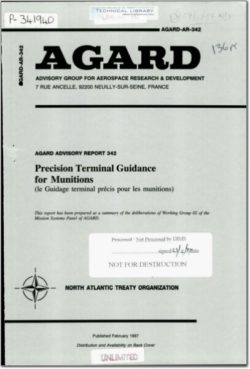
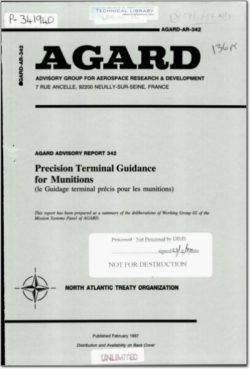
AGARD-AR-342 Precision Terminal Guidance for Munitions

The first meeting of the GCP's Working Group 13 (subsequently MSP Working Group 02) was held in the
autumn of 1992, eighteen months after the end of the Gulf War (Operation Desert Storm). In its Spring
1991 Business Meeting the GCP, prompted by the apparent success of guided munitions in Operation
Desert Storm, had also initiated a study (reference 1.1) of its implications for guidance and control. Two
important aspects of guided munitions employment in modem warfare were tested in that conflict: firstly,
precision attack and secondly, stand-off attack. Both aspects were featured in the symposium on "Advances
in Guidance and Control of Precision Guided Weapons." at the 54th meeting of the Guidance and Control
Panel in May 1992.

Precision guided air-to-surface munitions played a major role in Operation Desert Stomi, making it
possible to attack important targets, such as Iraqi command, control and communications assets, supply
routes, and resources, with a minimum of damage to civilian areas. More than in any previous conflict, the
avoidance of collateral damage was a major issue in mission planning and execution, becauSe of the
intense and — in the West — largely uncensored news media coverage. By avoiding the need for repeat
sorties, PGM also made an important contribution to reducing losses. It is reported for example that of the
90,000 tonnes or so of munitions delivered by US aircraft on Iraq and occupied Kuwait, 7% were precision
guided munitions, 90% of which hit their target, compared to only 25% of the conventional bombs that
were dropped. The implications are obvious.

The attack of heavily defended high-value fixed targets by stand-off munitions, though not one of the most
important factors in Operation Desert Stonn's success, was also a significant pointer for the future. The
circumstances of a limited — though intense — war emphasise the importance of air—launched and surface-
launched stand-off munitions as partial alternatives to manned aircraft missions and forward deployment of
ground and sea-bome forces.

A final issue of major importance to the Alliance was cost. The preceding Operation Desert Shield lasted
six months and involved transportation of immense quantities of materiel as well as personnel. The total
cost of the Gulf War, and the build-up to it, was some $53 billion. Clearly, improved munitions
effectiveness could have a dramatic impact on the indirect. cost of similar operations in the future by
alleviating the logistics burden, as well as on direct costs by reducing the required scale of operations.
Improvements in temiinal guidance to increase accuracy of delivery, autonomy of operation, resistance to
countenneasures, and adaptability in use, would all help to save cost.

FileAction
AGARD-AR-342 Precision Terminal Guidance for Munitions.pdfDownload 

Comment On This Post

Your email address will not be published. Required fields are marked *

AGARD-AR-342

AGARD-AR-342
  • Version
  • 243 Downloads
  • 17.46 MB File Size
  • 1 File Count
  • March 8, 2016 Create Date
  • March 8, 2016 Last Updated
Scroll for Details

Precision Terminal Guidance for Munitions

AGARD-AR-342 Precision Terminal Guidance for Munitions

The first meeting of the GCP's Working Group 13 (subsequently MSP Working Group 02) was held in the
autumn of 1992, eighteen months after the end of the Gulf War (Operation Desert Storm). In its Spring
1991 Business Meeting the GCP, prompted by the apparent success of guided munitions in Operation
Desert Storm, had also initiated a study (reference 1.1) of its implications for guidance and control. Two
important aspects of guided munitions employment in modem warfare were tested in that conflict: firstly,
precision attack and secondly, stand-off attack. Both aspects were featured in the symposium on "Advances
in Guidance and Control of Precision Guided Weapons." at the 54th meeting of the Guidance and Control
Panel in May 1992.

Precision guided air-to-surface munitions played a major role in Operation Desert Stomi, making it
possible to attack important targets, such as Iraqi command, control and communications assets, supply
routes, and resources, with a minimum of damage to civilian areas. More than in any previous conflict, the
avoidance of collateral damage was a major issue in mission planning and execution, becauSe of the
intense and — in the West — largely uncensored news media coverage. By avoiding the need for repeat
sorties, PGM also made an important contribution to reducing losses. It is reported for example that of the
90,000 tonnes or so of munitions delivered by US aircraft on Iraq and occupied Kuwait, 7% were precision
guided munitions, 90% of which hit their target, compared to only 25% of the conventional bombs that
were dropped. The implications are obvious.

The attack of heavily defended high-value fixed targets by stand-off munitions, though not one of the most
important factors in Operation Desert Stonn's success, was also a significant pointer for the future. The
circumstances of a limited — though intense — war emphasise the importance of air—launched and surface-
launched stand-off munitions as partial alternatives to manned aircraft missions and forward deployment of
ground and sea-bome forces.

A final issue of major importance to the Alliance was cost. The preceding Operation Desert Shield lasted
six months and involved transportation of immense quantities of materiel as well as personnel. The total
cost of the Gulf War, and the build-up to it, was some $53 billion. Clearly, improved munitions
effectiveness could have a dramatic impact on the indirect. cost of similar operations in the future by
alleviating the logistics burden, as well as on direct costs by reducing the required scale of operations.
Improvements in temiinal guidance to increase accuracy of delivery, autonomy of operation, resistance to
countenneasures, and adaptability in use, would all help to save cost.

FileAction
AGARD-AR-342 Precision Terminal Guidance for Munitions.pdfDownload 
17,005 Documents in our Technical Library
3207947 Total Downloads

Search The Technical Library

Newest Additions

NASA-RP-1060 Subsonic Aircraft: Evolution and the Matching of Size to Performance
AA-CP-20212-001
AA-CP-20212-001
ADPO10769 Occurrence of Corrosion in Airframes
The purpose of this lecture is to provide an overview ...
MIL-STD-1759 Rivets and Rivet Type Fasteners Preferred for Design
The purpose of this book form standard is to provide ...
MIL-STD-810G Environmental Engineering Considerations and Laboratory Tests
This standard contains materiel acquisition program planning and engineering direction ...