naca-report-389

naca-report-389
  • Version
  • 209 Downloads
  • 859.20 KB File Size
  • 1 File Count
  • August 26, 2016 Create Date
  • August 26, 2016 Last Updated
Scroll for Details

National Advisory Committee for Aeronautics, Report - The Effect of Small Angle of Yaw and Pitch on the Characteristics of Airplane Propellers
naca-report-389 The Effect of Small Angle of Yaw and Pitch on the Characteristics of Airplane Propellers-1
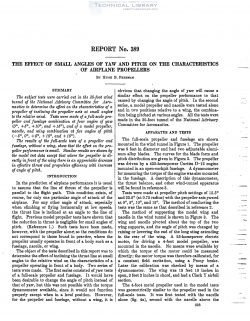
The subject tests were carried out in the 30-foot wind
tunnel of the National Advisory Committee for Aero-
nautics to determine the eject on the characteristics of a
propeller of inclining the propeller axis at small angles
to the relative wind. Tests were made of a full-scale pro-
peller and fuselage combination at four angles of yaw
(0°, +5°, +10°, and +15°), and of a model propeller,
nacelle, and wing combination at fire angles of pitch
(—5°, 0°, +5°, +10°, and +15°).
The results of the full—scale tests of a propeller and
fuselage, without a wing, show that the efl'ect on the pro-
peller performance is small. Similar results are shown by
the model test data except that where the propeller is di-
rectly in front of the wing there is an appreciable decrease
in efi'ectire thrust and propulsire eficiency with increase
of angle of pitch.
In the prediction of airplane performance it is usual
to assume that the line of thrust of the propeller is.
parallel to the flight path. This condition exists, of
course, for only one particular angle of attack of the
airplane. For any other angle of attack, especially
when climbing or flying horizontally at low speeds,
the thrust line is inclined at an angle to the line of
flight. Previous model propeller tests have shown that
the reduction in thrust is negligible for small angles of
pitch. (Reference 1.) Such tests have been made,
however, with the propeller alone; so the conditions do
not correspond to those found in practice, where the
propeller usually operates in front of a body such as a.
fuselage, nacelle, or wing.
The object of the tests described in this report was to
determine the effect of inclining the thrust line at small
angles to the relative wind on the characteristics of a
propeller operating in front of a body. Two series of
tests were made. The first series consisted of yaw tests
of a full-scale propeller and fuselage. It would have
been desirable to change the angle of pitch instead of
that of yaw, but this was not possible with the torque
dynamometer available, since it would not function
properly except when in a level position.

FileAction
naca-report-389 The Effect of Small Angle of Yaw and Pitch on the Characteristics of Airplane Propellers.pdfDownload 

Comment On This Post

Your email address will not be published. Required fields are marked *

naca-report-389

naca-report-389
  • Version
  • 209 Downloads
  • 859.20 KB File Size
  • 1 File Count
  • August 26, 2016 Create Date
  • August 26, 2016 Last Updated
Scroll for Details

National Advisory Committee for Aeronautics, Report - The Effect of Small Angle of Yaw and Pitch on the Characteristics of Airplane Propellers
naca-report-389 The Effect of Small Angle of Yaw and Pitch on the Characteristics of Airplane Propellers-1
The subject tests were carried out in the 30-foot wind
tunnel of the National Advisory Committee for Aero-
nautics to determine the eject on the characteristics of a
propeller of inclining the propeller axis at small angles
to the relative wind. Tests were made of a full-scale pro-
peller and fuselage combination at four angles of yaw
(0°, +5°, +10°, and +15°), and of a model propeller,
nacelle, and wing combination at fire angles of pitch
(—5°, 0°, +5°, +10°, and +15°).
The results of the full—scale tests of a propeller and
fuselage, without a wing, show that the efl'ect on the pro-
peller performance is small. Similar results are shown by
the model test data except that where the propeller is di-
rectly in front of the wing there is an appreciable decrease
in efi'ectire thrust and propulsire eficiency with increase
of angle of pitch.
In the prediction of airplane performance it is usual
to assume that the line of thrust of the propeller is.
parallel to the flight path. This condition exists, of
course, for only one particular angle of attack of the
airplane. For any other angle of attack, especially
when climbing or flying horizontally at low speeds,
the thrust line is inclined at an angle to the line of
flight. Previous model propeller tests have shown that
the reduction in thrust is negligible for small angles of
pitch. (Reference 1.) Such tests have been made,
however, with the propeller alone; so the conditions do
not correspond to those found in practice, where the
propeller usually operates in front of a body such as a.
fuselage, nacelle, or wing.
The object of the tests described in this report was to
determine the effect of inclining the thrust line at small
angles to the relative wind on the characteristics of a
propeller operating in front of a body. Two series of
tests were made. The first series consisted of yaw tests
of a full-scale propeller and fuselage. It would have
been desirable to change the angle of pitch instead of
that of yaw, but this was not possible with the torque
dynamometer available, since it would not function
properly except when in a level position.

FileAction
naca-report-389 The Effect of Small Angle of Yaw and Pitch on the Characteristics of Airplane Propellers.pdfDownload 
17,005 Documents in our Technical Library
3154008 Total Downloads

Search The Technical Library

Newest Additions

NASA-RP-1060 Subsonic Aircraft: Evolution and the Matching of Size to Performance
AA-CP-20212-001
AA-CP-20212-001
ADPO10769 Occurrence of Corrosion in Airframes
The purpose of this lecture is to provide an overview ...
MIL-STD-1759 Rivets and Rivet Type Fasteners Preferred for Design
The purpose of this book form standard is to provide ...
MIL-STD-810G Environmental Engineering Considerations and Laboratory Tests
This standard contains materiel acquisition program planning and engineering direction ...