NASA-TP-2208
- Version
- 277 Downloads
- 1.57 MB File Size
- 1 File Count
- May 18, 2016 Create Date
- May 18, 2016 Last Updated
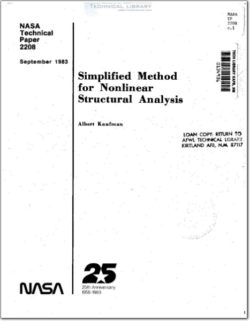
Simplified Method for Nonlinear Structural Analysis
Nonlinear, finite-element computer programs are too
costly to use in the early design stages for hot-section
components of aircraft gas turbine engines. To improve
the durability of these components, it is necessary to
develop simpler and more economical methods for
representing the structural response of materials under
cyclic loading. This study was conducted to develop a
computer program for performing a simplified nonlinear
structural analysis using only an elastic solution as input
data.
The simplified method was based on the assumption
that the inelastic regions in the structure are constrained
against stress redistribution by the surrounding elastic
material. Therefore the total strain history can be defined
by an elastic analysis. A computer program (ANSYMP)
was created to predict the stress-strain history at the
critical fatigue location of a thermomechanically cycled
structure from elastic input data. Appropriate material
stress-strain properties and a plasticity hardening model
were incorporated into the program. Effective stresses
and plastic strains are approximated by an iterative and
incremental solution procedure. Initial development of
the simplified inelastic analysis method considered only
plasticity effects. The method will be further developed
to account for creep and relaxation effects.
A series of three cases were analytically examined to
verify the accuracy of the simplified method. Verification
was made through comparison with a three-dimensional,
nonlinear, finite-element analysis (MARC). These cases
were (1) a uniaxial specimen subjected to strain cycling
under isothermal conditions; (2) a benchmark notch
specimen subjected to load cycling; and (3) a prismatic
wedge specimen subjected to thermal cycling. Monotonic
stress-strain properties for IN 100 alloy and a combined
isotropic-kinematic hardening model were assumed for
the uniaxial and wedge specimen problems. Cyclic stress-
strain properties for Inconel 718 alloy and a kinematic
hardening model were used for the benchmark notch
specimen problem.
| File | Action |
|---|---|
| NASA-TP-2208 Simplified Method for Nonlinear Structural Analysis.pdf | Download |
Comment On This Post