NASA-BRIEF-69-10186

  • Version
  • 37 Downloads
  • 116.05 KB File Size
  • 1 File Count
  • August 19, 2017 Create Date
  • August 19, 2017 Last Updated
Scroll for Details

Spherical Ion Source

A method of radial focusing electnons in an ion
source produces greater ion densities than have pre-
viously been available. The increased ion density
allows for higher resolution and focus capability for a
given source volume. Applications of this principle
can readily be transferred to sources used in mass
spectrometers, particle accelerators, leak detectors and
related instrumentation.

Conventional ion sources have a plasma density
which is‘spatially uniform. The extraction efficiency at
the exit slit is thus limited by lack of concentrated ion
density. Compromises must be made between a small
aperture (low current and high resolution) or a large
aperture (high current, poor focusing and low reso-
lution).

The electron beam is focused near the exit aperture
by use of spherical fields; the fact that the ions are
created at high density allows focusing the ion beam
to high density at the exit slit, thereby allowing high
current through a small aperture.

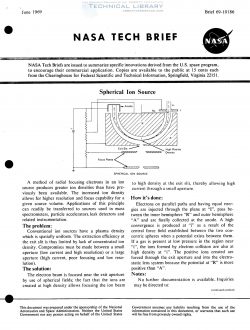
Electrons on parallel paths and having equal ener-
gies are injected through the plane at “I”, pass be-
tween the inner hemisphere “R” and outer hemisphere
“A” and are finally collected at the anode. A high
convergence is produced at “i” as a result of the
central force field established between the two con-
centric spheres when a potential exists between them.
If a gas is present at low pressure in the region near
“i”, the ions formed by electron collision are also at
high density at “i”. The positive ions created are
forced through the exit aperture and into the electro-
static lens system because the potential at “R” is more
positive than “A”.

FileAction
NASA-BRIEF-69-10186 Spherical Ion Source.pdfDownload 

Comment On This Post

Your email address will not be published. Required fields are marked *

NASA-BRIEF-69-10186

  • Version
  • 37 Downloads
  • 116.05 KB File Size
  • 1 File Count
  • August 19, 2017 Create Date
  • August 19, 2017 Last Updated
Scroll for Details

Spherical Ion Source

A method of radial focusing electnons in an ion
source produces greater ion densities than have pre-
viously been available. The increased ion density
allows for higher resolution and focus capability for a
given source volume. Applications of this principle
can readily be transferred to sources used in mass
spectrometers, particle accelerators, leak detectors and
related instrumentation.

Conventional ion sources have a plasma density
which is‘spatially uniform. The extraction efficiency at
the exit slit is thus limited by lack of concentrated ion
density. Compromises must be made between a small
aperture (low current and high resolution) or a large
aperture (high current, poor focusing and low reso-
lution).

The electron beam is focused near the exit aperture
by use of spherical fields; the fact that the ions are
created at high density allows focusing the ion beam
to high density at the exit slit, thereby allowing high
current through a small aperture.

Electrons on parallel paths and having equal ener-
gies are injected through the plane at “I”, pass be-
tween the inner hemisphere “R” and outer hemisphere
“A” and are finally collected at the anode. A high
convergence is produced at “i” as a result of the
central force field established between the two con-
centric spheres when a potential exists between them.
If a gas is present at low pressure in the region near
“i”, the ions formed by electron collision are also at
high density at “i”. The positive ions created are
forced through the exit aperture and into the electro-
static lens system because the potential at “R” is more
positive than “A”.

FileAction
NASA-BRIEF-69-10186 Spherical Ion Source.pdfDownload 
17,005 Documents in our Technical Library
3070935 Total Downloads

Search The Technical Library

Newest Additions

NASA-RP-1060 Subsonic Aircraft: Evolution and the Matching of Size to Performance
AA-CP-20212-001
AA-CP-20212-001
ADPO10769 Occurrence of Corrosion in Airframes
The purpose of this lecture is to provide an overview ...
MIL-STD-1759 Rivets and Rivet Type Fasteners Preferred for Design
The purpose of this book form standard is to provide ...
MIL-STD-810G Environmental Engineering Considerations and Laboratory Tests
This standard contains materiel acquisition program planning and engineering direction ...