naca-rm-a53a09
- Version
- 79 Downloads
- 2.09 MB File Size
- 1 File Count
- August 13, 2017 Create Date
- August 13, 2017 Last Updated
National Advisory Committee for Aeronautics, Research Memorandum - Buffeting of a Vertical Tail on an Inclined Body at Supersonic Mach Numbers
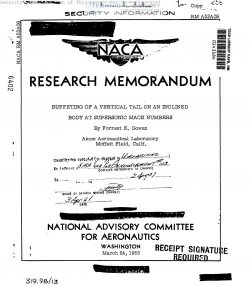
Time histories of rolling and yawing moments on inclined bodies of
revolution with vertical-tail surfaces were obtained at Mach numbers of
1.h5, 1.98, and 2.90 and in the range of Reynolds numbers (based on body
diameter) from 0.2 million to 1.3 million. Three ogival-nosed bodies
(fineness ratio 5 tangent ogives) with over-all fineness ratios of 9.6,
12.0, and 1h.h and a conicalunosed body with a fineness ratio of 12.0
were tested. These tests were made in an angle—of-attack range from
00 to about 3&0 which included the angle-of-attack range where insta-
bility in the cross flow first occurred. The measurements of rolling
and yawing moments were preceded by visual—flow studies of the cross-
flow field at Mach numbers of l.h5 and 1.98 and supplemented at the
same Mach numbers by time histories of the surface—pressure fluctuations
on the body alone at a longitudinal station 10.6 diameters from the nose
of the model. Typical records of both force and pressure measurements
are included along with representative photographs of the cross-flow
field obtained with schlieren_apparatus and with the vapor—screen tech-
nique.
Although the side forces and yawing moments were small, it was found
that large rolling moments which fluctuated in a random manner accompa-
nied the changing vortex pattern in the cross-flow wake. These rolling-
moment fluctuations were reduced in magnitude by increasing the Mach
number or by changing the nose shape from a sharp conical nose (small
apex-angle cone) to an ogival nose. Increasing the distance from the
tip of the ogival nose to the tail position was found to result in an
increase in the magnitude of the rolling-moment fluctuations and a
reduction in the angle-of-attack range at which the fluctuations occurred.
Large fluctuations of surface pressure were also found to accompany the
aperiodic fluctuating cross-flow wake. These pressure variations were
found to occur over most Of the lee side of the body at a longitudinal
station 10.6 diameters from the nose.
It has long been recognized that the effects of viscosity have an
important influence on the flow over inclined bodies of revolution. In
fact, both the steady and unsteady forces and moments are influenced by
'these viscous effects. Recently,a practical semiempirical method for
evaluating the steady-state forces and moments on a slender body of
revolution has been developed by Allen in reference 1. However, no
evaluation of the effects of viscosity on the unsteady forces has been
made.
| File | Action |
|---|---|
| naca-rm-a53a09 Buffeting of a Vertical Tail on an Inclined Body at Supersonic Mach Numbers.pdf | Download |
Comment On This Post