naca-report-713

naca-report-713
  • Version
  • 194 Downloads
  • 2.02 MB File Size
  • 1 File Count
  • August 30, 2016 Create Date
  • August 30, 2016 Last Updated
Scroll for Details

National Advisory Committee for Aeronautics, Report - Internal Flow Systems for Aircraft
naca-report-713 Internal Flow Systems for Aircraft-1

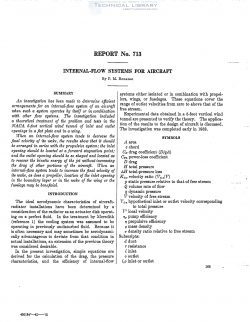
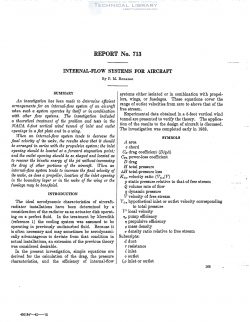
An investigation has bee-n made to determine efii‘cient
arrangements for an internal-flow system of an aircraft
when such a system operates by itself or in combination
with other flow systems. The investigation included
a theoretical treatment of the problem and tests in the
NAOA 5-foot vertical wind tunnel of inlet and outlet
openings in a flat plate and in a wing.

When an internal-flow system tends to decrease the
final velocity of its mice, the results showthat it should
be arranged in series with the propulsive system; the inlet
opening should be located at a forward stagnation point;
and the outlet opening should be soshaped and located as
to recover the kinetic energy of the jet without increasing
the drag of other portions of the aircraft. When an
internal—flow system tends to increase the final velocity of
its wake, as does a propeller, location of the inlet opening
in the boundary layer or in the wake of the wing or the
fuselage may be beneficial.

The ideal aerodynamic characteristics of aircraft-
radiator installations have been determined by a‘
consideration of the radiator as an actuator disk operat-
ing on a perfect fluid. In thetreatment by Meredith
(reference 1) the cooling system was assumed to be
operating in previously undisturbed fluid. Because it
is often necessary and may sometimes be aerodynami-
cally advantageous to deviate from that condition in
actual installations, an extension of the previous theory
was considered desirable.

In the present investigation, simple equations are
derived for the calculation of the drag, the pressure
characteristics, and the efficiency of internal-flow
systems either isolated or in combination with propel-
lers, Wings, or fuselages. These equations cover the
range of out-let velocities from zero to above that of the
free stream.

FileAction
naca-report-713 Internal Flow Systems for Aircraft.pdfDownload 

Comment On This Post

Your email address will not be published. Required fields are marked *

naca-report-713

naca-report-713
  • Version
  • 194 Downloads
  • 2.02 MB File Size
  • 1 File Count
  • August 30, 2016 Create Date
  • August 30, 2016 Last Updated
Scroll for Details

National Advisory Committee for Aeronautics, Report - Internal Flow Systems for Aircraft

naca-report-713 Internal Flow Systems for Aircraft-1

An investigation has bee-n made to determine efii‘cient
arrangements for an internal-flow system of an aircraft
when such a system operates by itself or in combination
with other flow systems. The investigation included
a theoretical treatment of the problem and tests in the
NAOA 5-foot vertical wind tunnel of inlet and outlet
openings in a flat plate and in a wing.

When an internal-flow system tends to decrease the
final velocity of its mice, the results showthat it should
be arranged in series with the propulsive system; the inlet
opening should be located at a forward stagnation point;
and the outlet opening should be soshaped and located as
to recover the kinetic energy of the jet without increasing
the drag of other portions of the aircraft. When an
internal—flow system tends to increase the final velocity of
its wake, as does a propeller, location of the inlet opening
in the boundary layer or in the wake of the wing or the
fuselage may be beneficial.

The ideal aerodynamic characteristics of aircraft-
radiator installations have been determined by a‘
consideration of the radiator as an actuator disk operat-
ing on a perfect fluid. In thetreatment by Meredith
(reference 1) the cooling system was assumed to be
operating in previously undisturbed fluid. Because it
is often necessary and may sometimes be aerodynami-
cally advantageous to deviate from that condition in
actual installations, an extension of the previous theory
was considered desirable.

In the present investigation, simple equations are
derived for the calculation of the drag, the pressure
characteristics, and the efficiency of internal-flow
systems either isolated or in combination with propel-
lers, Wings, or fuselages. These equations cover the
range of out-let velocities from zero to above that of the
free stream.

FileAction
naca-report-713 Internal Flow Systems for Aircraft.pdfDownload 
17,005 Documents in our Technical Library
3130773 Total Downloads

Search The Technical Library

Newest Additions

NASA-RP-1060 Subsonic Aircraft: Evolution and the Matching of Size to Performance
AA-CP-20212-001
AA-CP-20212-001
ADPO10769 Occurrence of Corrosion in Airframes
The purpose of this lecture is to provide an overview ...
MIL-STD-1759 Rivets and Rivet Type Fasteners Preferred for Design
The purpose of this book form standard is to provide ...
MIL-STD-810G Environmental Engineering Considerations and Laboratory Tests
This standard contains materiel acquisition program planning and engineering direction ...