naca-report-649

naca-report-649
  • Version
  • 231 Downloads
  • 833.87 KB File Size
  • 1 File Count
  • August 30, 2016 Create Date
  • August 30, 2016 Last Updated
Scroll for Details

National Advisory Committee for Aeronautics, Report - The Pack Method of Compressive Tests of Thin Specimens of Materials Used in Thin Wall Structures
naca-report-649 The Pack Method of Compressive Tests of Thin Specimens of Materials Used in Thin Wall Structures-1

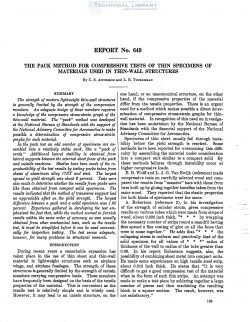
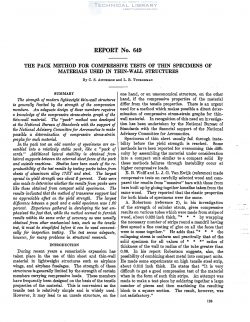
The strength of modern lightweight thin-wall structures
is generally limited by the strength of the compression
members. An adeguate design of these members requires
a knowledge of the compressive stress-strain graph of the
thin-wall material. The “pac ” method was developed
at the National Bureau of Standards with the support of
the National Advisory Committee for Aeronautics to make
possible a determination of compressii'e stress-strain
graphs for such material.

In the pack test an odd number of specimens are as-
sembled into a relaticely stable poets, like a “pack of
cards.” Additional lateral stability is obtained from
lateral supports between the external sheet faces of the pack
and outside reactions. Studies hare been made of the re-
producibility of the test results by testing packs taken from
sheets of aluminum alloy 178T and steel. The largest
spread in yield strength was about 2 percent. Tests were
also made to determine whether the results from packs were
like those obtained from compact solid specimens. The
results indicated that the method of transrerse support had
no appreciable efiect on the yield strength. The largest
difi'erence between a pack and a solid specimen was 1.60
percent. Experience gathered in developing the test em-
phasized the fact that, while the method seemed to furnish
results within the same order of accuracy as was usually
obtained from other mechanical tests, such as the tensile
test, it must be simplified before it can be used economi—
cally for inspection testing. The test seems adequate,
however, for many problems in structural research.

During recent years a remarkable expansion has
taken place in the use of thin sheet and thin-wall
material in lightweight structures such as airplane
wings, and airplane fuselages. The strength of these
structures is generally limited by the strength of certain
members carrying compressive loads. These members
have frequently been designed on the basis of the tensile
properties of the material. This is convenient as the
tensile test is relatively simple and is widely used.

FileAction
naca-report-649 The Pack Method of Compressive Tests of Thin Specimens of Materials Used in Thin Wall Structures.pdfDownload 

Comment On This Post

Your email address will not be published. Required fields are marked *

naca-report-649

naca-report-649
  • Version
  • 231 Downloads
  • 833.87 KB File Size
  • 1 File Count
  • August 30, 2016 Create Date
  • August 30, 2016 Last Updated
Scroll for Details

National Advisory Committee for Aeronautics, Report - The Pack Method of Compressive Tests of Thin Specimens of Materials Used in Thin Wall Structures

naca-report-649 The Pack Method of Compressive Tests of Thin Specimens of Materials Used in Thin Wall Structures-1

The strength of modern lightweight thin-wall structures
is generally limited by the strength of the compression
members. An adeguate design of these members requires
a knowledge of the compressive stress-strain graph of the
thin-wall material. The “pac ” method was developed
at the National Bureau of Standards with the support of
the National Advisory Committee for Aeronautics to make
possible a determination of compressii'e stress-strain
graphs for such material.

In the pack test an odd number of specimens are as-
sembled into a relaticely stable poets, like a “pack of
cards.” Additional lateral stability is obtained from
lateral supports between the external sheet faces of the pack
and outside reactions. Studies hare been made of the re-
producibility of the test results by testing packs taken from
sheets of aluminum alloy 178T and steel. The largest
spread in yield strength was about 2 percent. Tests were
also made to determine whether the results from packs were
like those obtained from compact solid specimens. The
results indicated that the method of transrerse support had
no appreciable efiect on the yield strength. The largest
difi'erence between a pack and a solid specimen was 1.60
percent. Experience gathered in developing the test em-
phasized the fact that, while the method seemed to furnish
results within the same order of accuracy as was usually
obtained from other mechanical tests, such as the tensile
test, it must be simplified before it can be used economi—
cally for inspection testing. The test seems adequate,
however, for many problems in structural research.

During recent years a remarkable expansion has
taken place in the use of thin sheet and thin-wall
material in lightweight structures such as airplane
wings, and airplane fuselages. The strength of these
structures is generally limited by the strength of certain
members carrying compressive loads. These members
have frequently been designed on the basis of the tensile
properties of the material. This is convenient as the
tensile test is relatively simple and is widely used.

FileAction
naca-report-649 The Pack Method of Compressive Tests of Thin Specimens of Materials Used in Thin Wall Structures.pdfDownload 
17,005 Documents in our Technical Library
3115293 Total Downloads

Search The Technical Library

Newest Additions

NASA-RP-1060 Subsonic Aircraft: Evolution and the Matching of Size to Performance
AA-CP-20212-001
AA-CP-20212-001
ADPO10769 Occurrence of Corrosion in Airframes
The purpose of this lecture is to provide an overview ...
MIL-STD-1759 Rivets and Rivet Type Fasteners Preferred for Design
The purpose of this book form standard is to provide ...
MIL-STD-810G Environmental Engineering Considerations and Laboratory Tests
This standard contains materiel acquisition program planning and engineering direction ...