AGARD AD-A199 171

AGARD AD-A199 171
  • Version
  • 370 Downloads
  • 12.46 MB File Size
  • 1 File Count
  • April 26, 2016 Create Date
  • April 26, 2016 Last Updated
Scroll for Details

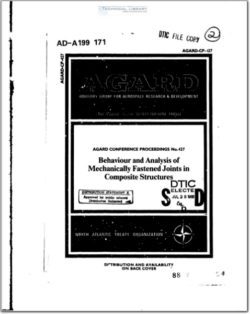
Behavior and Analysis of Mechanically Fastened Joints in Composite Structures
AGARD AD-A199 171 Analysis of Joint in Composite Structure
This report presents a llteratus review of the state-of-the-art analytical and experimental methodologies adopted
in the aerospace industry for the design of mechanically fastened joints in composite structures. Results and conclusions
obtained from the published llterattre relating to the effects of critical parameters, which include composite material
system, fastener configuration and joint geometry. on the mechanical behaviour and failure modes of composite
mechaniuily fastened joints are dlacmsed. Fu-ther research required to improve the design of composite mechanically
fastened joints is identified as a result of this review.
The purpose of this literature review is to assess the state-of-the—art analytical and experimental methodologies
for the design of composite mechanically fastened joints. This review aims at providing a basis for identifying further
research in these areas.
Joints that require mechanical fasteners such as bolts, rivets or pins to cont- :t two or more parts in a structure
where the transfer of loads is provided by the fasteners are generically described as mechanically fastened joints. This is
in contrast to adiesively bonded joints where thr- cunnecting and load transfer medium is the adhesive layer.
Mechanically fastened joints are required in cases where the need for component disassembly is entailed.
One of the more challenging aspects of composite mechanically fastened joints is that the well-established design
procedures for metal joints, that are based on years of experience with isotropic and homogeneous materials. have to be
changed in order to accommodate the anisotropic and nonhomogeneous properties of composite materials. Also.
advanced composites have practically none of the forgiving capabilities of metals which yield to redistribute loads and
thus reduce the sensitivity to local stress concentrations. The inherent matrix weaknesses of composites, especially
organic matrix compositesI render the joints susceptible to interlaminar shear failtres as a result of matrix stresses.
Analytical procedures for the prediction of static strength and fatigue life of composite nechanicaiiy fastened
joints are presented in Section 2. The application of finite element and two-dimensional elasticity methods in stress
analyses and the adoption of failure criteria in static strength predictions are discussed. Curent methods for fatigue
life prediction are also discussed.

FileAction
AGARD AD-A199 171 Analysis of Joint in Composite Structure.pdfDownload 

Comment On This Post

Your email address will not be published. Required fields are marked *

AGARD AD-A199 171

AGARD AD-A199 171
  • Version
  • 370 Downloads
  • 12.46 MB File Size
  • 1 File Count
  • April 26, 2016 Create Date
  • April 26, 2016 Last Updated
Scroll for Details

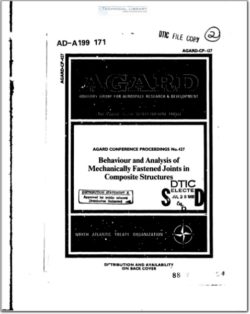
Behavior and Analysis of Mechanically Fastened Joints in Composite Structures
AGARD AD-A199 171 Analysis of Joint in Composite Structure
This report presents a llteratus review of the state-of-the-art analytical and experimental methodologies adopted
in the aerospace industry for the design of mechanically fastened joints in composite structures. Results and conclusions
obtained from the published llterattre relating to the effects of critical parameters, which include composite material
system, fastener configuration and joint geometry. on the mechanical behaviour and failure modes of composite
mechaniuily fastened joints are dlacmsed. Fu-ther research required to improve the design of composite mechanically
fastened joints is identified as a result of this review.
The purpose of this literature review is to assess the state-of-the—art analytical and experimental methodologies
for the design of composite mechanically fastened joints. This review aims at providing a basis for identifying further
research in these areas.
Joints that require mechanical fasteners such as bolts, rivets or pins to cont- :t two or more parts in a structure
where the transfer of loads is provided by the fasteners are generically described as mechanically fastened joints. This is
in contrast to adiesively bonded joints where thr- cunnecting and load transfer medium is the adhesive layer.
Mechanically fastened joints are required in cases where the need for component disassembly is entailed.
One of the more challenging aspects of composite mechanically fastened joints is that the well-established design
procedures for metal joints, that are based on years of experience with isotropic and homogeneous materials. have to be
changed in order to accommodate the anisotropic and nonhomogeneous properties of composite materials. Also.
advanced composites have practically none of the forgiving capabilities of metals which yield to redistribute loads and
thus reduce the sensitivity to local stress concentrations. The inherent matrix weaknesses of composites, especially
organic matrix compositesI render the joints susceptible to interlaminar shear failtres as a result of matrix stresses.
Analytical procedures for the prediction of static strength and fatigue life of composite nechanicaiiy fastened
joints are presented in Section 2. The application of finite element and two-dimensional elasticity methods in stress
analyses and the adoption of failure criteria in static strength predictions are discussed. Curent methods for fatigue
life prediction are also discussed.

FileAction
AGARD AD-A199 171 Analysis of Joint in Composite Structure.pdfDownload 
17,005 Documents in our Technical Library
3063556 Total Downloads

Search The Technical Library

Newest Additions

NASA-RP-1060 Subsonic Aircraft: Evolution and the Matching of Size to Performance
AA-CP-20212-001
AA-CP-20212-001
ADPO10769 Occurrence of Corrosion in Airframes
The purpose of this lecture is to provide an overview ...
MIL-STD-1759 Rivets and Rivet Type Fasteners Preferred for Design
The purpose of this book form standard is to provide ...
MIL-STD-810G Environmental Engineering Considerations and Laboratory Tests
This standard contains materiel acquisition program planning and engineering direction ...