naca-report-1238

  • Version
  • 167 Downloads
  • 3.46 MB File Size
  • 1 File Count
  • November 2, 2016 Create Date
  • November 2, 2016 Last Updated
Scroll for Details

National Advisory Committee for Aeronautics, Report - Investigations at Supersonic Speeds of 22 Triangular Wings Representing Two Airfoils Sections for Each of 11 Apex Angles
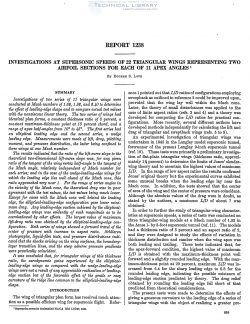
naca-report-1238-investigations-at-supersonic-speeds-of-22-triangular-wings-representing-two-airfoils-sections-for-each-of-11-apex-angles-1

Investigations of two series of 11 triangular wings were
conducted at Mach numbers of 1.6.9, 1.92, and 240 to determine
the efi'ect of leading-edge shape and to compare actual test values
with the nonviscous linear theory. The two series of wings had
identical plan forms, a constant thickness ratio of 8 percent, a
constant maximum-thickness point at 18 percent chord, and a
range of apes: half-angles from 10° to 45°. The first series had
an elliptical leading edge and the second series, a wedge
leading edge. Measurements were made of lift, drag, pitching
moment, and pressure distribution, the latter being confined to
three wings at one Mach number.

The results indicated that the ratio of the lift-curve slope to the
theoretical two-dimensional lift—curve slope was, for any given
ratio of the tangent of the wing vertex half-angle to the tangent of
the lilach angle, relatively independent of Mach number for
each series; and in the case of the wedge—leading—edge wings for
which the leading edge lies well ahead of the Mach cone, this
ratio approached very near 1. For the range of vertex angles in
the vicinity of the Mach cone, the theoretical drag was in poor
agreement with the test values, the test values being much lower.
Except for cases with the Mach cone well behind the leading
edge, the elliptical-leading-edge configuration gave lower mini-
mum drag. Any leading-edge suction achieved by the elliptical-
leading-edge wings was evidently of such magnitude as to be
overshadowed by other effects. The largest value of maximum
lift-drag ratio was obtained by the elliptical-leading-edge con-
figuration. Both series of wings showed aforward travel of the
center of pressure with increase in aspect ratio. Schlieren
photographs, liguidjilm tests, and pressure distributions indi—
cated that the shocks arising on the wing surfaces, the boundary-
layer transition lines, and the steep adverse pressure gradients
were practically coincident.

It was concluded that, for triangular wings of this thickness
ratio, the aerodynamic gains atpaienced by the ellipticalr
leading-edge wings as compared with the wedge-leading-edge
wings were not a result of any appreciable realization of leading-
edge suction but of the favorable efiect of the gentle or easy
curvature of the ridge line common to the elliptical-leading-edge
shape.

FileAction
naca-report-1238 Investigations at Supersonic Speeds of 22 Triangular Wings Representing Two Airfoils Sections for Each of 11 Apex Angles.pdfDownload 

Comment On This Post

Your email address will not be published. Required fields are marked *

naca-report-1238

  • Version
  • 167 Downloads
  • 3.46 MB File Size
  • 1 File Count
  • November 2, 2016 Create Date
  • November 2, 2016 Last Updated
Scroll for Details

National Advisory Committee for Aeronautics, Report - Investigations at Supersonic Speeds of 22 Triangular Wings Representing Two Airfoils Sections for Each of 11 Apex Angles

naca-report-1238-investigations-at-supersonic-speeds-of-22-triangular-wings-representing-two-airfoils-sections-for-each-of-11-apex-angles-1

Investigations of two series of 11 triangular wings were
conducted at Mach numbers of 1.6.9, 1.92, and 240 to determine
the efi'ect of leading-edge shape and to compare actual test values
with the nonviscous linear theory. The two series of wings had
identical plan forms, a constant thickness ratio of 8 percent, a
constant maximum-thickness point at 18 percent chord, and a
range of apes: half-angles from 10° to 45°. The first series had
an elliptical leading edge and the second series, a wedge
leading edge. Measurements were made of lift, drag, pitching
moment, and pressure distribution, the latter being confined to
three wings at one Mach number.

The results indicated that the ratio of the lift-curve slope to the
theoretical two-dimensional lift—curve slope was, for any given
ratio of the tangent of the wing vertex half-angle to the tangent of
the lilach angle, relatively independent of Mach number for
each series; and in the case of the wedge—leading—edge wings for
which the leading edge lies well ahead of the Mach cone, this
ratio approached very near 1. For the range of vertex angles in
the vicinity of the Mach cone, the theoretical drag was in poor
agreement with the test values, the test values being much lower.
Except for cases with the Mach cone well behind the leading
edge, the elliptical-leading-edge configuration gave lower mini-
mum drag. Any leading-edge suction achieved by the elliptical-
leading-edge wings was evidently of such magnitude as to be
overshadowed by other effects. The largest value of maximum
lift-drag ratio was obtained by the elliptical-leading-edge con-
figuration. Both series of wings showed aforward travel of the
center of pressure with increase in aspect ratio. Schlieren
photographs, liguidjilm tests, and pressure distributions indi—
cated that the shocks arising on the wing surfaces, the boundary-
layer transition lines, and the steep adverse pressure gradients
were practically coincident.

It was concluded that, for triangular wings of this thickness
ratio, the aerodynamic gains atpaienced by the ellipticalr
leading-edge wings as compared with the wedge-leading-edge
wings were not a result of any appreciable realization of leading-
edge suction but of the favorable efiect of the gentle or easy
curvature of the ridge line common to the elliptical-leading-edge
shape.

FileAction
naca-report-1238 Investigations at Supersonic Speeds of 22 Triangular Wings Representing Two Airfoils Sections for Each of 11 Apex Angles.pdfDownload 
17,005 Documents in our Technical Library
3179337 Total Downloads

Search The Technical Library

Newest Additions

NASA-RP-1060 Subsonic Aircraft: Evolution and the Matching of Size to Performance
AA-CP-20212-001
AA-CP-20212-001
ADPO10769 Occurrence of Corrosion in Airframes
The purpose of this lecture is to provide an overview ...
MIL-STD-1759 Rivets and Rivet Type Fasteners Preferred for Design
The purpose of this book form standard is to provide ...
MIL-STD-810G Environmental Engineering Considerations and Laboratory Tests
This standard contains materiel acquisition program planning and engineering direction ...

Popular Items