
NASA-TM-102120
- Version
- 369 Downloads
- 611.36 KB File Size
- 1 File Count
- December 13, 2015 Create Date
- December 13, 2015 Last Updated
Simplified Procedures for Designing Adhesively Bonded Composite Joints
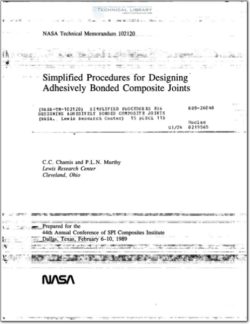
Procedures for the preliminary design of composite adhesive joints are
described. Typical joints, their respective free body diagrams and approxi—
mate equations for estimating the stresses in each of these typical joints are
summarized. Equations are also presented to check the critical conditions of
the joint, such as: minimum length, maximum adhesive shear stress and peel—off
stress. To illustrate the procedure, sample designs are described in step—by—
step fashion for a butt joint with single doubler subjected to static loads,
cyclic loads and environmental effects. The results show that (l) unsymmetric
adhesive joints are inefficient and should be avoided, and (2) hygrothermal
environments and cyclic loads dramatically reduce the structural integrity of
the joint and require several joint lengths compared to those for static load
with no environmental effects.
The structural integrity of composite structures is often times determined
by the integrity and durability of their respective joints. The two general
classes of joints are mechanical fasteners and adhesive bonding. Both types
of joints receive continuous attention in the fiber composites community. For
example, ASTM Specialty Symposia are devoted to composite joints (ref. 1).
Recent books on composites technology include chapters with extensive discus—
sions (refs. 2 and 3) as well as entire books written on adhesively bonded
joints (ref. 4). The discussions in these sources mainly deal with important
details in composite joint design. No single source is available which sum—
marizes step-by—step procedures for the preliminary design of composite joints.
It is generally accepted that the structural integrity of mechanical fas-
tener joints mainly depends on the local laminate bearing strength while that
for adhesively bonded joints mainly depends on local interlaminar shear
strength. Recent research at NASA Lewis Research Center focused on developing
simplified methods for predicting microstresses and local laminate strengths
including interlaminar strengths (ref. 5). In a previous paper (ref. 6),
these methods were used to design bolted composite joints. In the present
paper these methods are used to design adhesively bonded joints for composite
structures. The objective of the paper is to describe these methods and to
outline a step-by-step procedure for the preliminary design of adhesively
bonded joints. Numerical examples are included to illustrate applications to
static loads and cyclic loads, including hot-wet service environments.
| File | Action |
|---|---|
| NASA-TM-102120 Simplified Procedures for Designing Adhesively Bonded Composite Joints.pdf | Download |
Comment On This Post