
17,005 Documents in our Technical Library
3250456 Total Downloads

Newest Additions

NASA-RP-1060 Subsonic Aircraft: Evolution and the Matching of Size to Performance
AA-CP-20212-001
AA-CP-20212-001
ADPO10769 Occurrence of Corrosion in Airframes
The purpose of this lecture is to provide an overview ...
MIL-STD-1759 Rivets and Rivet Type Fasteners Preferred for Design
The purpose of this book form standard is to provide ...
MIL-STD-810G Environmental Engineering Considerations and Laboratory Tests
This standard contains materiel acquisition program planning and engineering direction ...

naca-tn-2422

  • Version
  • 93 Downloads
  • 1.77 MB File Size
  • 1 File Count
  • December 14, 2016 Create Date
  • December 14, 2016 Last Updated
Scroll for Details

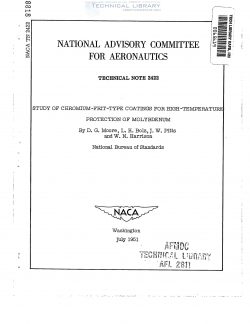
National Advisory Committee for Aeronautics, Technical Notes - Study of Chromium-Frit-Type Coatings for High Temperature Protection of Molybdenum
One of the properties of molybdenum metal which restrict its use
in jet-engine applications is its poor resistance to oxidation. Above
its melting point of 11630 F, the molybdenum trioxide evaporates rapidly,
giving no protection to the metal.

A number of attempts have been made to protect molybdenum against
this rapid oxidation by the application of a suitable coating. An
earlier study in this laboratory (reference 1) resulted in several
coating compositions which gave short-time (less than 1 hr) pfotection
in high-velocity gas streams of 30000 to 35000 F. Other laboratories
have also worked on the problem, but there are no published reports
describing these studies.

Recent work with titanium-carbide ceramal demonstrated that both
excellent adherence and good high-temperature protection against
oxidation could be achieved when chromium-frit coatings were applied
to this material (reference 2). The fact that chromium forms a solid
solution with molybdenum at elevated temperatures (reference 3) in-
dicated that similar coatings, when properly applied and fired, might
be effective in protecting molybdemm. The high thermal expansion of
chromium as compared with that of molybdenum was expected to be an
undesirable feature, inasmuch as the coating would be in tension rather
than in compression after firing and cooling; however, it was believed
possible that the glass present in the coating would tend to flow
sufficiently under operating conditions to seal any cracks that might
occur', and thus provide protection. A few exploratory applications
showed that the chromium-frit coatings could be bonded to
molybdenum by relatively simple laboratory procedures and that the
resulting coatings, while showing some tendency to craze, were never-
theless promising in their effectiveness in protecting the metal from
oxidation at elevated temperatures. Because of these results, a more
complete investigation of chromium-frit coatings was undertaken.

The present report, which gives the results of this investigation,
is based upon research carried out at the National Bureau of Standards
under the sponsorship and with the financial assistance of the National
Advisory Committee for Aeronautics.

FileAction
naca-tn-2422 Study of Chromium-Frit-Type Coatings for High Temperature Prtection of Molybdenum.pdfDownload 

Comment On This Post

Your email address will not be published. Required fields are marked *

naca-tn-2422

  • Version
  • 93 Downloads
  • 1.77 MB File Size
  • 1 File Count
  • December 14, 2016 Create Date
  • December 14, 2016 Last Updated
Scroll for Details

National Advisory Committee for Aeronautics, Technical Notes - Study of Chromium-Frit-Type Coatings for High Temperature Protection of Molybdenum

One of the properties of molybdenum metal which restrict its use
in jet-engine applications is its poor resistance to oxidation. Above
its melting point of 11630 F, the molybdenum trioxide evaporates rapidly,
giving no protection to the metal.

A number of attempts have been made to protect molybdenum against
this rapid oxidation by the application of a suitable coating. An
earlier study in this laboratory (reference 1) resulted in several
coating compositions which gave short-time (less than 1 hr) pfotection
in high-velocity gas streams of 30000 to 35000 F. Other laboratories
have also worked on the problem, but there are no published reports
describing these studies.

Recent work with titanium-carbide ceramal demonstrated that both
excellent adherence and good high-temperature protection against
oxidation could be achieved when chromium-frit coatings were applied
to this material (reference 2). The fact that chromium forms a solid
solution with molybdenum at elevated temperatures (reference 3) in-
dicated that similar coatings, when properly applied and fired, might
be effective in protecting molybdemm. The high thermal expansion of
chromium as compared with that of molybdenum was expected to be an
undesirable feature, inasmuch as the coating would be in tension rather
than in compression after firing and cooling; however, it was believed
possible that the glass present in the coating would tend to flow
sufficiently under operating conditions to seal any cracks that might
occur', and thus provide protection. A few exploratory applications
showed that the chromium-frit coatings could be bonded to
molybdenum by relatively simple laboratory procedures and that the
resulting coatings, while showing some tendency to craze, were never-
theless promising in their effectiveness in protecting the metal from
oxidation at elevated temperatures. Because of these results, a more
complete investigation of chromium-frit coatings was undertaken.

The present report, which gives the results of this investigation,
is based upon research carried out at the National Bureau of Standards
under the sponsorship and with the financial assistance of the National
Advisory Committee for Aeronautics.

FileAction
naca-tn-2422 Study of Chromium-Frit-Type Coatings for High Temperature Prtection of Molybdenum.pdfDownload 
17,005 Documents in our Technical Library
3250456 Total Downloads

Search The Technical Library

Newest Additions

NASA-RP-1060 Subsonic Aircraft: Evolution and the Matching of Size to Performance
AA-CP-20212-001
AA-CP-20212-001
ADPO10769 Occurrence of Corrosion in Airframes
The purpose of this lecture is to provide an overview ...
MIL-STD-1759 Rivets and Rivet Type Fasteners Preferred for Design
The purpose of this book form standard is to provide ...
MIL-STD-810G Environmental Engineering Considerations and Laboratory Tests
This standard contains materiel acquisition program planning and engineering direction ...