
ARC-RM-946
- Version
- 256 Downloads
- 3.12 MB File Size
- 1 File Count
- June 16, 2016 Create Date
- June 16, 2016 Last Updated
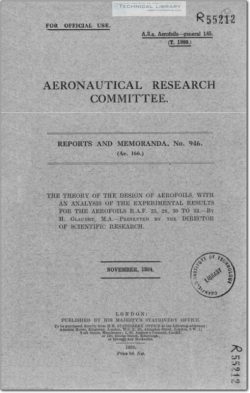
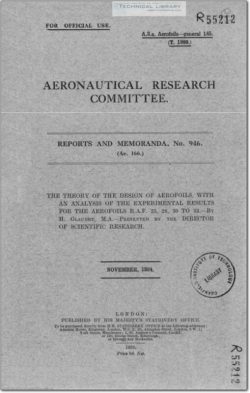
The Theory of the Design of Aerofoils, With an Analysis of the Experimental Results for the Aerofoils R.A.F. 25, 26, 30 to 33
The aim of aerofoil design is therefore to obtain an aerofoil
shape which will give the required circulation or lift force with
as low a profile drag as possible. Limitations are also imposed
by structural considerations, since the aerofoil must have suffi-
cient thickness to enclose suitable wing spars, and since it is
also desirable that the movement of the centre of pressure with
changing angle of incidence shall not be too rapid.
Now in two dimensional motion a circular arc of camber 'y,
set at zero angle of incidence, gives rise theoretically to a lift
coefficient 16L : 2 773/ when the flow enters the leading edge
and leaves the trailing edge smoothly. The drag under these .
conditions would be of the same order of magnitude as the skin
frictional drag of a flat plate. From aerodynamic considerations
alone, a circular arc of suitable camber would therefore appear
to be the ideal method of producing the required lift.
In practice the thin circular arc would be unsatisfactory for two
reasons, firstly that a certain thickness is necessary for structural
reasons, and secondly that at any other angle of incidence the
flow would not enter the leading edge smoothly. Both theSe
objections are removed if a suitable symmetrical fairing is placed
round the circular arc, so that the aerofoil is essentially a
symmetrical section whose centre line has been curved into a
circular arc of the requisite camber. Actually also the minimum
drag of a good symmetrical section is less than the frictional drag
of a flat plate. An aerofoil of this type would be expected to
have its minimum profile drag approximately equal to that of the
symmetrical section, associated with the lift coefficient 70L 2 2 77 y;
This conclusion applies to two dimensional motion and will
also apply to a finite wing of elliptic plan form, where all the
elements work at the same effective incidence. It should also
be approximately true for a wing of rectangular plan form.
The choice of the symmetrical fairing is still open, and the
main consideration is that it should have a low minimum drag.
Itsthickness must be sufficient to enclose suitable spars, but
for different purposes it may be desirable to have a relatively
thick section or a relatively thin one. The practical range is
probably covered by a maximum thickness from 5 per cent. to
15 per cent. of the chord.
| File | Action |
|---|---|
| ARC-RM-946 The Theory of the Design of Aerofoils, With an Analysis of the Experimental Results for the Aerofoils R.A.F. 25, 26, 30 to 33.pdf | Download |
Comment On This Post