
17,005 Documents in our Technical Library
3250484 Total Downloads

Newest Additions

NASA-RP-1060 Subsonic Aircraft: Evolution and the Matching of Size to Performance
AA-CP-20212-001
AA-CP-20212-001
ADPO10769 Occurrence of Corrosion in Airframes
The purpose of this lecture is to provide an overview ...
MIL-STD-1759 Rivets and Rivet Type Fasteners Preferred for Design
The purpose of this book form standard is to provide ...
MIL-STD-810G Environmental Engineering Considerations and Laboratory Tests
This standard contains materiel acquisition program planning and engineering direction ...

DOT-FAA-AR-00-22

DOT-FAA-AR-00-22
  • Version
  • 290 Downloads
  • 19.25 MB File Size
  • 1 File Count
  • March 24, 2016 Create Date
  • March 24, 2016 Last Updated
Scroll for Details

Corrosion and Corrosion Fatigue of Airframe Materials
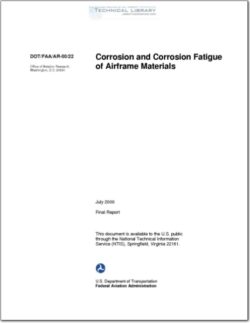
DOT-FAA-AR-00-22 Corrosion and Corrosion Fatigue of Airframe Materials

In support of the National Aging Aircraft Research Program (NAARP) of the Federal Aviation
Administration (FAA), Lehigh University undertook a multidisciplinary program of research to
study corrosion and corrosion fatigue of airframe materials. The program was initiated on 15
June 1992 for a 3-year period as Phase I and was extended from 15 June 1995 to 30 September
1999 as Phase II. It was complemented by a companion program under the sponsorship of the
Air Force office of Scientific Research (AFOSR). The objectives of these programs are (l) the
development of a basic understanding of the processes of localized corrosion and corrosion
fatigue crack nucleation and growth in high-strength aluminum alloys used in airframe
construction, (2) the formulation of kinetic models for these elemental processes, and (3) the
integration of these models into probabilistic models that can provide guidance in formulating
methodologies for service—life prediction and airworthiness assessment. Experimental efforts
under the FAA-sponsored program were directed at the 2024-T3 aluminum alloy, while those
under the AFOSR-sponsored program were concentrated on the 7075-T651 alloy. This report
summarizes research performed under the Phase 11 program from 15 June 1995 to 30 September
1999 and includes modeling efforts in which shared FAA and AFOSR sponsorship necessarily
occurred.

Research under these programs has demonstrated the efficacy and value of using a
multidisciplinary, mechanistically based probability approach to address the issues of aging of
civil and military aircraft. Localized corrosion and corrosion fatigue (acting in competition)
have been shown to be a principal material aging mechanism in structural aluminum alloys used
in aircraft construction. The operation of this mechanism in service is confirmed by teardown
inspection data from the lower wing panels and stiffeners from two transport aircraft that had
been in commercial service for about 24 and 30 years. It is supported by preliminary
metallographic information from the lower wing panels of one of the aircraft. Localized
corrosion nucleated at constituent particles in highly stressed areas of aluminum alloys through
particle—induced galvanic attack of the matrix and grew from particle to particle in a cluster or
contiguous clusters of particles to form severe corrosion pits. These severe pits (on the order of
50 to 200 um in depth) served as nuclei for fatigue cracking and can reduce the fatigue (crack
growth) life by a factor of 10. Localized corrosion, therefore, is deemed to be the principal
contributor to the early onset of multisite (fatigue) damage (MSD), and its impact on structural
integrity and flight safety needs to be assessed.

FileAction
DOT-FAA-AR-00-22 Corrosion and Corrosion Fatigue of Airframe Materials.pdfDownload 

Comment On This Post

Your email address will not be published. Required fields are marked *

DOT-FAA-AR-00-22

DOT-FAA-AR-00-22
  • Version
  • 290 Downloads
  • 19.25 MB File Size
  • 1 File Count
  • March 24, 2016 Create Date
  • March 24, 2016 Last Updated
Scroll for Details

Corrosion and Corrosion Fatigue of Airframe Materials

DOT-FAA-AR-00-22 Corrosion and Corrosion Fatigue of Airframe Materials

In support of the National Aging Aircraft Research Program (NAARP) of the Federal Aviation
Administration (FAA), Lehigh University undertook a multidisciplinary program of research to
study corrosion and corrosion fatigue of airframe materials. The program was initiated on 15
June 1992 for a 3-year period as Phase I and was extended from 15 June 1995 to 30 September
1999 as Phase II. It was complemented by a companion program under the sponsorship of the
Air Force office of Scientific Research (AFOSR). The objectives of these programs are (l) the
development of a basic understanding of the processes of localized corrosion and corrosion
fatigue crack nucleation and growth in high-strength aluminum alloys used in airframe
construction, (2) the formulation of kinetic models for these elemental processes, and (3) the
integration of these models into probabilistic models that can provide guidance in formulating
methodologies for service—life prediction and airworthiness assessment. Experimental efforts
under the FAA-sponsored program were directed at the 2024-T3 aluminum alloy, while those
under the AFOSR-sponsored program were concentrated on the 7075-T651 alloy. This report
summarizes research performed under the Phase 11 program from 15 June 1995 to 30 September
1999 and includes modeling efforts in which shared FAA and AFOSR sponsorship necessarily
occurred.

Research under these programs has demonstrated the efficacy and value of using a
multidisciplinary, mechanistically based probability approach to address the issues of aging of
civil and military aircraft. Localized corrosion and corrosion fatigue (acting in competition)
have been shown to be a principal material aging mechanism in structural aluminum alloys used
in aircraft construction. The operation of this mechanism in service is confirmed by teardown
inspection data from the lower wing panels and stiffeners from two transport aircraft that had
been in commercial service for about 24 and 30 years. It is supported by preliminary
metallographic information from the lower wing panels of one of the aircraft. Localized
corrosion nucleated at constituent particles in highly stressed areas of aluminum alloys through
particle—induced galvanic attack of the matrix and grew from particle to particle in a cluster or
contiguous clusters of particles to form severe corrosion pits. These severe pits (on the order of
50 to 200 um in depth) served as nuclei for fatigue cracking and can reduce the fatigue (crack
growth) life by a factor of 10. Localized corrosion, therefore, is deemed to be the principal
contributor to the early onset of multisite (fatigue) damage (MSD), and its impact on structural
integrity and flight safety needs to be assessed.

FileAction
DOT-FAA-AR-00-22 Corrosion and Corrosion Fatigue of Airframe Materials.pdfDownload 
17,005 Documents in our Technical Library
3250484 Total Downloads

Search The Technical Library

Newest Additions

NASA-RP-1060 Subsonic Aircraft: Evolution and the Matching of Size to Performance
AA-CP-20212-001
AA-CP-20212-001
ADPO10769 Occurrence of Corrosion in Airframes
The purpose of this lecture is to provide an overview ...
MIL-STD-1759 Rivets and Rivet Type Fasteners Preferred for Design
The purpose of this book form standard is to provide ...
MIL-STD-810G Environmental Engineering Considerations and Laboratory Tests
This standard contains materiel acquisition program planning and engineering direction ...